Disclosure: This post contains affiliate links, including Amazon Associates links. If you buy through them, we may earn a commission at no extra cost to you. As an Amazon Associate I earn from qualifying purchases
Note: This article discusses cold-water immersion for recovery. It is not medical advice. Consult a qualified healthcare provider before starting cold therapy, especially if you have cardiovascular, respiratory, or other medical conditions.
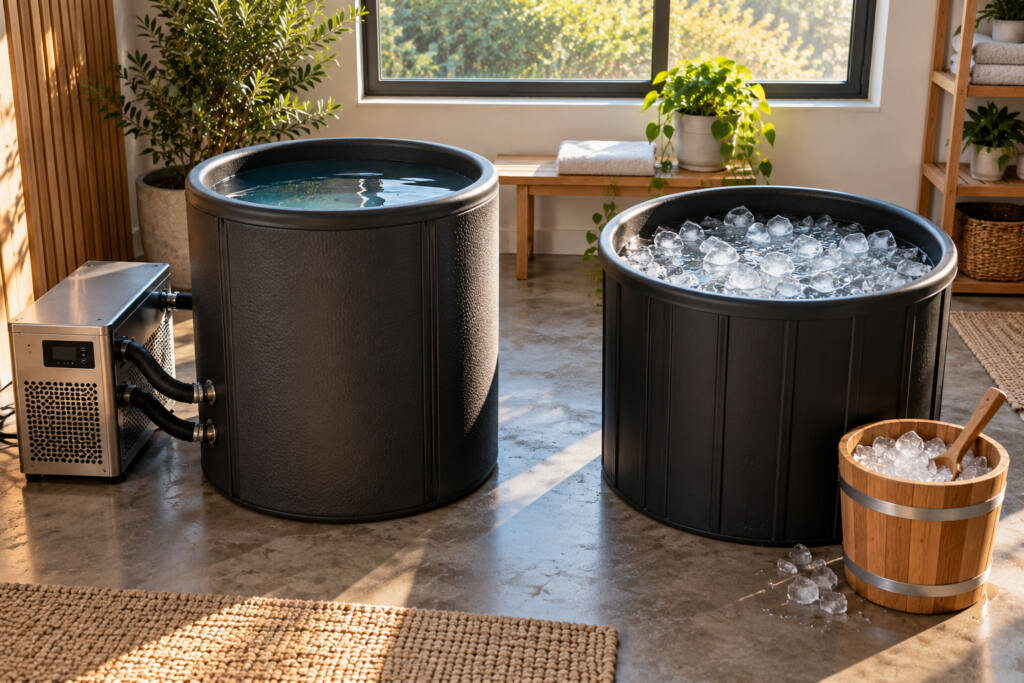
Cold plunges and ice baths are often marketed as if they are two completely different recovery methods.
They are not.
Both are forms of cold-water immersion. Your body does not know whether 50°F water was cooled by a $4,000 refrigeration system or by three bags of ice from the grocery store.
If the water temperature, immersion depth, and time are the same, the basic cold exposure is essentially the same.
The real difference is how you create and maintain that cold water.
An ice bath is the simple version: fill a tub with water, add ice, check the temperature, and get in.
A refrigerated cold plunge adds a chiller, circulation, and usually filtration. You set a temperature and the system maintains it, potentially keeping the water ready for repeated use.
That convenience can cost anywhere from several hundred dollars for a basic pod-and-chiller setup to $5,000-$8,000 or more for an integrated premium plunge.
So which should you buy?
The most common comment in cold plunge communities from new owners is not about recovery benefits — it is surprise at how much work the ice becomes. That is the single most useful reason to start cheaply.
Bottom Line
For recovery effectiveness alone, neither a cold plunge nor an ice bath has an inherent advantage if they produce the same cold-water immersion protocol.
Research supports cold-water immersion primarily as a tool for reducing perceived muscle soreness and potentially helping certain short-term recovery outcomes after strenuous exercise. It does not establish that mechanically chilled water works better than ice-cooled water.
The buying decision is therefore mostly about convenience.
Choose an ice bath if you are new to cold exposure, use it occasionally, have a tight budget, live in a small space, or are not sure you will stick with the habit.
Choose a refrigerated cold plunge if you use cold-water immersion several times per week and want predictable temperature, less ice handling, filtration, and a tub that is ready when you are.
The Pod Company Long Pod + Chiller
For a premium permanent installation where convenience matters more than price, an integrated system such as the Plunge All-In Gen 2 eliminates most of the daily setup. It currently cools as low as 37°F, uses a 120V dedicated circuit, and includes filtration and ozone sanitation.
For most beginners, however, I would start with an ice bath rather than spending several thousand dollars immediately. If you are still plunging consistently six months later, adding a chiller becomes much easier to justify.
In current home-wellness terminology, a “cold plunge” usually means a tub with a mechanical water chiller.
You fill the tub once, connect the cooling system, choose a temperature, and allow the chiller to bring the water down to that temperature.
Better systems also circulate and filter the water.
Premium models can add:
- Ozone sanitation
- Insulated covers
- Smartphone controls
- Automatic temperature management
- Heating capability
- Fine-particle filtration
- Integrated pumps
- Scheduled operation
The biggest benefit is consistency.
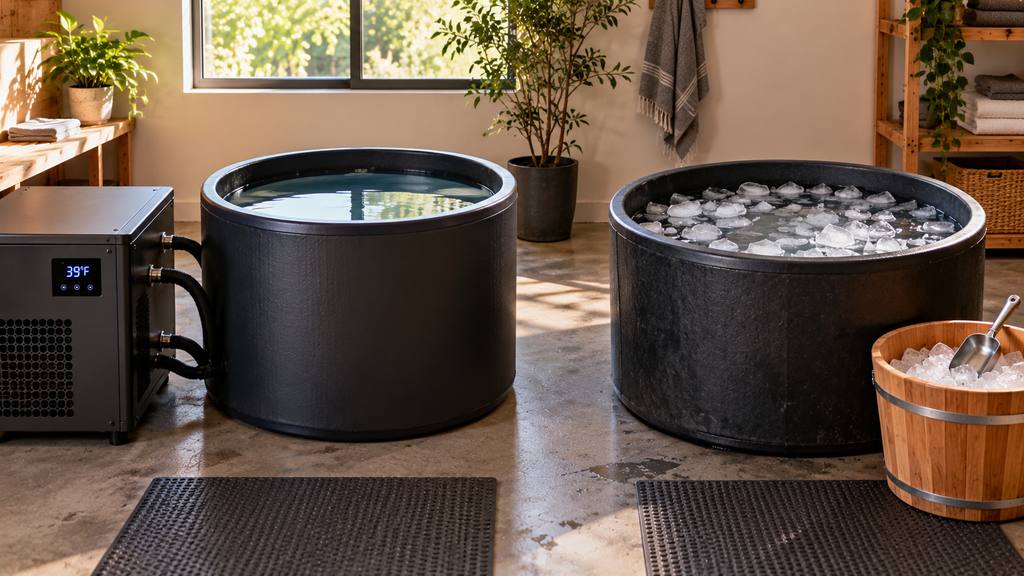
If you want 50°F water at 6:30 every morning, a properly sized cold plunge can keep it close to 50°F without requiring you to buy and carry bags of ice every day.
How Cold Does a Cold Plunge Get?
It depends on the system.
The Plunge All-In Gen 2, for example, is currently rated to cool down to 37°F.
The Pod Company’s current Standard Chiller is rated down to approximately 41°F, while its higher-performance current chiller options can reach the upper 30s under suitable conditions.
But colder is not automatically better.
Research on exercise recovery frequently uses temperatures considerably warmer than near-freezing water. A widely cited review of athletic recovery literature noted that protocols around 50-59°F (10-15°C) for approximately 5-15 minutes appeared useful for performance recovery, although the ideal protocol depends on the situation.
You therefore do not need a 37°F plunge simply because your equipment can reach 37°F.
What Does a Cold Plunge Cost?
This category has an enormous price range.
A soft-sided tub combined with a separate chiller can cost under $1,000 during promotions.
A rigid insulated tub plus a high-end chiller can run several thousand dollars.
An integrated premium system can cost considerably more. The Plunge All-In Gen 2, for example, was listed at $7,990 at the time of writing.
The important question is not simply whether you can afford the equipment.
It is whether you will use it enough to justify paying for convenience.
What Is an Ice Bath?
An ice bath produces the same basic outcome using a much simpler method.
You put water in a container and add ice until it reaches your desired temperature.
The container could be:
- A bathtub
- Portable insulated pod
- Stock tank
- Rigid cold-therapy barrel
- Dedicated inflatable tub
No compressor is necessary.
No pump is necessary for a basic setup.
And no electricity is necessary.
The Advantages Are Simplicity and Price
The Pod Company’s Ice Pod Pro, for example, currently starts around $79 during promotional pricing and measures about 32 inches in diameter.
The much more substantial Ice Barrel 300 currently costs $1,149.99, measures 35.5″W × 35.5″D × 30.5″H, holds 77 gallons, and can be used either with ice or an optional chiller.
That gives you an unusually wide price range.
You can test cold-water immersion for less than $100 or spend more than $1,000 on a durable insulated tub without committing to a powered cooling system.
The Disadvantage Is Ice
The problem appears after you start using the bath regularly.
The Pod Company recommends roughly 15-40 pounds of ice per session, depending on tap-water temperature, climate, and target temperature.
If you have a large freezer and make your own ice, the financial cost can be manageable.
If you buy 20-40 pounds of bagged ice several times per week, the routine becomes expensive and inconvenient surprisingly quickly.
That is the point where a chiller starts making sense.
| Factor | Refrigerated cold plunge | Ice bath |
| Recovery method | Cold-water immersion | Cold-water immersion |
| Typical temperature control | Precise and repeatable | Depends on ice and starting water temperature |
| Setup before each session | Minimal once running | Add and mix ice |
| Upfront cost | Roughly $650 to $8,000+ | Roughly $80 to $1,200+ for a dedicated tub |
| Ongoing cost | Electricity, filters, sanitation | Ice, water, cleaning |
| Filtration | Common | Usually none unless added |
| Temperature consistency | Excellent | Variable |
| Noise | Compressor/pump noise | None |
| Electricity needed | Yes | No |
| Portability | Depends on model | Usually better |
| Best for | Frequent users | Beginners and occasional users |
Temperature
A chiller wins easily for temperature control.
Set it to 50°F and, assuming the equipment is appropriately sized for the climate and installation, it can maintain water near that temperature.
An ice bath requires more judgment.
Your tap water might be 50°F during winter and 80°F during summer. The amount of ice required to reach the same final temperature therefore changes throughout the year.
You need a thermometer if you want repeatable sessions.
But temperature consistency is a convenience advantage, not proof of better recovery.
If both tubs contain 50°F water, the mechanically chilled one does not become physiologically special because a compressor cooled it.
Timing
A refrigerated plunge can be ready immediately.
That matters more than it sounds.
After a hard run or training session, there is a meaningful behavioral difference between:
Take off shoes → get in plunge
and:
Drive to store → buy ice → carry ice home → fill tub → add ice → stir → check temperature → add more ice → wait → get in
If you use cold-water immersion occasionally, the difference is minor.
If you use it five times per week, convenience can determine whether you actually continue the routine.
Cost
The ice bath wins upfront.
It is not close.
A portable pod can cost less than $100 during a sale. A premium integrated plunge can cost thousands.
But recurring ice changes the long-term calculation.
Suppose you spend $8 on ice per session and plunge four times per week.
That is:
$8 × 4 × 4.33 = about $139 per month
Over a year:
About $1,664
Your actual cost may be much lower if you make ice at home, live somewhere with cold tap water, or reuse already-cold water.
But frequent bagged-ice purchases can eventually make a chiller economically reasonable.
Setup Complexity
The ice bath wins here initially.
Put tub down.
Fill tub.
Add ice.
A chiller introduces:
- Electricity
- Hoses
- Pumping
- Filters
- Ventilation clearance
- Condensation
- Water treatment
- Equipment maintenance
An integrated cold plunge can simplify those components, but you are paying for that integration.
The Plunge All-In Gen 2, for example, is designed as a fill-and-plug-in system with integrated filtration and ozone, but it weighs 238 pounds empty and approximately 1,150 pounds filled. It also requires a dedicated 120V/15A circuit according to the current manufacturer specifications.
That is easy to operate.
It is not necessarily easy to move.
Recovery Effectiveness
This is where the comparison becomes much simpler.
If the immersion protocol is equivalent, there is no good reason to expect an ice-cooled bath and mechanically chilled plunge to produce meaningfully different recovery effects.
The research investigates cold-water immersion.
It does not establish a special recovery advantage from the refrigeration method.
What matters more is:
- Water temperature
- Immersion duration
- How much of the body is immersed
- When you use it
- What type of exercise you performed
- What recovery outcome you care about
A 50°F bathtub can therefore be a perfectly legitimate cold-water immersion setup.
A $7,000 plunge does not make 50°F water more physiologically cold.
Athletes who have compared both setups often report the same thing: the recovery feels identical at 50°F, but the refrigerated plunge is what they actually use consistently. Convenience is the real variable.
Athletes: Usually a Cold Plunge if Use Is Frequent
If you train or compete frequently and deliberately use cold-water immersion as part of recovery, a refrigerated plunge becomes easier to justify.
The benefit is repeatability.
You can control temperature and timing without worrying whether there is enough ice in the freezer.
This is particularly useful during:
- Tournaments
- High-volume training blocks
- Back-to-back competition
- Endurance events
- Hot-weather training
Research suggests cold-water immersion can help with perceived soreness and some recovery outcomes, but the response depends on exercise type and timing.
There is also an important warning for strength athletes, which we will cover below.
General Wellness: Either
If you simply enjoy cold immersion and use it because you feel alert or refreshed afterward, you do not necessarily need a refrigerated system.
Start cheaply.
If the routine becomes something you use almost every day, upgrade later.
Be especially skeptical of broad claims that a cold plunge will automatically transform immunity, hormones, metabolism, mental health, or longevity. Those claims go well beyond what the exercise-recovery evidence can establish.
If you are also interested in heat therapy, see our guide to infrared sauna blankets for apartments.
Tight Budget: Ice Bath
This is the easiest category.
Spend $80-$200 on a portable tub rather than $4,000 on a refrigeration system.
To see the best specific tubs in that price range that won’t violate a lease, see our portable cold plunge options for renters.
Use it for several months.
If you hate buying ice but love cold immersion, you have learned something useful before spending thousands.
Small Space: Portable Ice Bath
A vertical pod can have a surprisingly small footprint.
The standard Ice Pod is approximately 32 inches in diameter and 27 inches tall, according to current manufacturer specifications.
That can work in a shower area, small patio, or other location where a 6-foot horizontal plunge cannot.
But filled weight still matters.
Water weighs about 8.34 pounds per gallon.
Do not put a full plunge on an apartment balcony simply because the empty tub weighs only a few pounds.
Beginners: Ice Bath
Beginners have another reason to start cheaply:
You may discover that you dislike cold immersion.
There is no recovery benefit from a $6,000 plunge you stop using after three weeks.
Start at a tolerable temperature rather than trying to prove you can sit in near-freezing water.
Colder is not automatically more effective.
Cold-water immersion has been studied extensively, but the conclusions require some nuance.
It Can Help With Muscle Soreness
This is probably the most defensible recovery claim.
A systematic review and meta-analysis of 28 studies found cold-water immersion superior to several other recovery methods for muscle soreness, while effects on measures such as muscular power and flexibility were more comparable with other approaches.
A newer 2026 systematic review and meta-analysis similarly found improvements in delayed-onset muscle soreness and some muscle-damage markers, but did not find corresponding improvements in maximal isometric strength or countermovement-jump recovery overall.
That distinction matters.
Feeling less sore is not the same thing as fully restoring performance.
Performance Results Are Mixed
A large systematic review involving 68 studies found that cold-water immersion improved some short- and longer-term recovery outcomes, but the effects depended on the exercise and time point.
It improved short-term endurance recovery in some circumstances, while immediate sprint or jump performance could actually be impaired.
A 2026 meta-analysis also found a temporary reduction in countermovement-jump performance immediately after cold-water immersion, with that effect no longer apparent later.
So if you have another explosive event in 20 minutes, jumping into extremely cold water may not be the obvious recovery strategy.
There Is No Magic Temperature
Cold-water immersion research uses a range of protocols.
A practical review of the literature identified 50-59°F for roughly 5-15 minutes as a commonly useful range for performance recovery.
Another systematic review examining muscle soreness found benefits across different water temperatures and protocols, with short-to-medium immersion durations showing positive effects.
That does not mean 50°F for 10 minutes is the perfect prescription for everyone.
It means you should be suspicious of the idea that a plunge must reach 35°F to “work.”
Strength and Muscle Growth Require More Caution
If your main goal is maximizing muscle growth from resistance training, routinely plunging immediately after every lifting session may not be ideal.
A meta-analysis found that regular cold-water immersion associated with resistance training could attenuate strength adaptations, although the available studies and protocols have limitations.
Other research has reported blunted muscle-fiber hypertrophy and anabolic signaling when cold-water immersion was repeatedly used after resistance exercise.
The practical takeaway is not that lifters must avoid cold water forever.
It is that recovery and adaptation are not exactly the same goal.
If you have another competition tomorrow, reducing soreness may be valuable.
If you are in a long training block focused specifically on maximizing hypertrophy, routinely using cold-water immersion immediately after every lifting session deserves more caution.
What About General Health Claims?
Evidence for post-exercise recovery should not be stretched into evidence for every claim associated with cold plunging.
The fact that cold-water immersion can reduce soreness does not prove that buying a cold plunge will:
- Prevent disease
- Produce meaningful long-term weight loss
- Cure anxiety or depression
- Dramatically increase testosterone
- Extend lifespan
- “Detox” your body
Those are different questions requiring different evidence.
For recovery, the research is useful but not magical.
If you read the actual studies rather than the marketing summaries, the honest takeaway is that cold water works for soreness but is not a magic performance booster. That is less exciting than the claims you see on Instagram, but it is what the data supports.
The best product depends more on how often you will use it than on recovery effectiveness.
Cold Plunge Options
The Pod Company Long Pod + Chiller
The Long Pod gives you a horizontal 62″L × 27″W × 21″H tub with 126 gallons of capacity. The current Standard Chiller bundle has recently been priced around $848, while configurations and promotional prices change frequently.
The Standard Chiller is rated to approximately 41°F and uses a regular 110V US plug.
Pros: Much cheaper than an integrated rigid plunge, chiller included, filtration, comfortable horizontal shape, portable tub.
Cons: Soft-sided construction, separate chiller and hoses, requires more setup than an integrated unit.
The Ice Barrel 300 costs $1,149.99 for the tub alone and measures 35.5 inches square by 30.5 inches high. It holds 77 gallons and weighs 61 pounds empty or approximately 700 pounds filled.
It is chiller-ready, so you can start with ice and add powered cooling later.
Ice Barrel’s own current chiller is substantially more expensive at about $3,999.99, making the complete branded setup a premium purchase.
Pros: Excellent small footprint, rigid insulated construction, internal seat, easy to start with ice and upgrade later.
Cons: Expensive with the branded chiller, upright position, approximately 700-pound filled weight.
The All-In Gen 2 is for someone who wants the equipment to disappear into the routine.
It currently costs around $7,990, cools to 37°F, holds about 105 gallons, and incorporates cooling, circulation, filtration, ozone sanitation, and app controls.
Its footprint is substantial at approximately 76¾”L × 31½”W × 28¾”H.
Pros: Integrated system, automatic cooling, filtration and ozone, app control, no ice purchases.
Cons: Very expensive, large footprint, approximately 1,150 pounds filled, dedicated electrical circuit required.
The Ice Pod Pro currently starts around $79 during promotions, though pricing changes regularly.
Its compact upright design makes it particularly useful for renters and people who do not know whether cold-water immersion will become a long-term habit.
Pros: Cheap, compact, lightweight when empty, no electricity required.
Cons: Requires ice, soft-sided construction, less comfortable than a horizontal tub for some users.
If you dislike crouching inside a vertical pod, the Long Pod is a more comfortable alternative.
It measures 62″L × 27″W × 21″H, weighs 17 pounds empty, and currently costs around $199 without a chiller.
It also has two chiller connections, so you can convert it to a refrigerated plunge later.
Pros: Comfortable shape, low price, portable, upgradeable.
Cons: 62-inch length requires more floor space, still needs ice initially.
The Ice Barrel 300 costs considerably more than a portable pod, but you are getting a rigid, insulated tub designed for long-term use.
At $1,149.99, it is difficult to call it a budget ice bath.
But it offers one major advantage: you can use ice now and connect a chiller later.
That makes it a sensible middle ground for someone who wants to build the system gradually.
FAQ
Is a cold plunge better than an ice bath for muscle recovery?
Not inherently.
Both are forms of cold-water immersion. If temperature, duration, and immersion depth are equivalent, there is no established recovery advantage simply because one tub uses a mechanical chiller.
The cold plunge’s advantage is repeatability and convenience.
Once you’ve decided on cold immersion, the next decision is which cold plunge type fits your apartment — inflatable or hard-shell.
If you are looking to combine cold therapy with heat for a more advanced recovery protocol, see our guide to combining a sauna and cold plunge setup.
How cold should an ice bath be?
You do not need near-freezing water.
Research protocols vary, but roughly 50-59°F (10-15°C) has been commonly studied for exercise recovery.
Beginners should prioritize a tolerable, controlled exposure rather than chasing the lowest possible number.
How long should you stay in a cold plunge?
There is no single universally optimal duration.
Research frequently uses exposures in the range of several minutes up to around 15 minutes, with temperature and duration interacting.
Longer and colder are not automatically better.
Should I cold plunge immediately after lifting weights?
Not automatically.
If your priority is rapid recovery for another event or training session, cold-water immersion may be useful.
If your primary goal is maximizing muscle growth and long-term resistance-training adaptations, repeatedly using cold-water immersion immediately after lifting may be counterproductive.
To understand exactly how long you should stay in the water based on your temperature and goals, see our full guide on how long to stay in a cold plunge.
Is 40°F better than 50°F?
There is no good basis for assuming that 40°F automatically produces better recovery than 50°F.
The scientific literature includes effective protocols at temperatures considerably warmer than 40°F.
Use temperature as a dosing variable, not a competition.
How much ice does an ice bath need?
It depends heavily on your starting water temperature, tub volume, weather, and target temperature.
The Pod Company recommends approximately 15-40 pounds per session as a general range for its products.
A thermometer is more useful than blindly following a fixed number of bags.
Is buying a chiller cheaper than buying ice?
It can be if you plunge frequently.
If bagged ice costs you $5-$10 per session and you plunge four or five times per week, recurring ice expenses can become substantial.
A chiller costs much more upfront but replaces most of that repeated ice purchasing.
For a full comparison of chillers for apartments, see our guide to the 4 best cold plunge chillers under $1,500.
For budget-friendly chillers, see our guide to cold plunge chillers under $1,000.
If you’re still deciding on a tub, see our inflatable cold plunge roundup for renter-friendly options.
Can I use my bathtub instead?
Yes.
If your bathtub is large enough for the desired level of immersion and you can cool the water adequately, it can provide cold-water immersion without buying a specialized tub.
Protect the plumbing from large quantities of loose ice and use common sense around slippery bathroom surfaces.
For a full guide to bathroom cold plunge setups, see our article on setting up a cold plunge in a small bathroom.
If you have outdoor space, see our guide to setting up a cold plunge on a small balcony.
If you have a garage, see our complete guide to setting up a cold plunge in a garage.
Can I keep the same water in a cold plunge?
A properly designed refrigerated plunge with circulation, filtration, and appropriate water treatment can generally maintain water much longer than a basic unfiltered ice bath.
Follow the equipment manufacturer’s sanitation and water-change instructions.
A tub full of cold water is not automatically sanitary simply because it looks clear.
For a complete guide on how to test, filter, and sanitize the water safely, see our guide to how to keep cold plunge water clean.
Is cold plunging safe for everyone?
No.
Cold-water immersion produces an acute cardiovascular and respiratory response, particularly when you first enter the water. People with cardiovascular disease or other relevant medical conditions, pregnant people, and anyone unsure whether cold immersion is appropriate for them should get individualized medical guidance before starting.
Do not use alcohol before cold-water immersion, and avoid practices that increase drowning risk. Beginners should not treat breath-holding or extreme exposure as part of the challenge.
For recovery itself, this is not really a cold plunge versus ice bath decision.
It is a cold-water immersion versus no cold-water immersion decision.
The water-cooling method is secondary.
An ice bath can provide the same basic cold exposure as a refrigerated plunge if you achieve the same temperature, immersion, and duration.
So make the purchase decision based on frequency.
If you are new to cold therapy, buy an inexpensive ice bath.
Spend $80-$200 rather than several thousand dollars. Use a thermometer, start conservatively, and find out whether cold-water immersion actually becomes part of your routine.
If you want more comfort but still want to start with ice, the Long Pod is a useful middle ground.
If you are plunging three to seven times per week and buying ice has become the main reason you skip sessions, that is when a chiller starts making practical sense.
The Pod Company Long Pod + Chiller
If you want a rigid tub with a small footprint and the option to upgrade gradually, consider the Ice Barrel 300.
And if your priority is a permanent, ready-to-use system with minimal daily preparation and the purchase price is secondary, an integrated plunge such as the Plunge All-In Gen 2 is the cleaner solution.
But do not spend $5,000-$8,000 because you believe refrigerated water provides a special form of recovery that ice water cannot.
It does not.
A premium cold plunge buys convenience, temperature control, filtration, and consistency. It does not buy a different physiological form of cold-water immersion.
The research suggests cold-water immersion can reduce post-exercise soreness and may improve certain recovery outcomes, particularly in situations where rapid recovery between hard efforts matters. The evidence is much less convincing for many of the broader wellness claims attached to cold plunging, and routine immediate use after resistance training may interfere with some long-term muscle and strength adaptations.
For most buyers, the sensible progression is:
Bathtub or inexpensive ice bath → establish the habit → add a chiller if inconvenience becomes the limiting factor → buy a premium integrated plunge only when you know you will use it enough to justify the cost.
That approach gives you essentially the same cold-water immersion without paying thousands of dollars before you know whether you actually want cold plunging to be part of your recovery routine.
The best progression I have seen from experienced cold-plunge owners is almost always the same: cheap tub first, prove the habit, add a chiller later, and only buy the premium integrated system if the cheaper setup is the thing holding you back.
For compact setups designed around apartments, balconies, and small bathrooms, see our guide to the 3 best small cold plunges for apartments, showers, and balconies.
If you are building a combined hot-and-cold recovery area in a garage, see our guide to setting up a sauna in a garage.
And for the electricity side of a home sauna setup, see our complete US breakdown of sauna running costs.
This post contains affiliate links. If you buy through them, we may earn a commission at no extra cost to you.