
Disclosure: This post contains affiliate links. If you buy through them, we may earn a commission at no extra cost to you.
A sauna in garage space is one of the most practical additions you can make to a US home, especially if the electrical panel is nearby and the concrete floor is level.
You already have a large, relatively open space. The floor is usually concrete. You do not have to sacrifice a bedroom.
And if your electrical panel is in or near the garage, installing the dedicated circuit required by a traditional electric sauna may be simpler than running wiring across the house.
But a garage is not automatically sauna-ready.
Unheated garages experience bigger temperature swings than normal living spaces. They can be humid, dusty, poorly insulated, and accessible to insects and rodents. Traditional electric saunas generally need 240V hardwired service, while even plug-in infrared cabins often call for a dedicated circuit.
The good news is that you usually do not need to convert the entire garage into a finished room.
For most homeowners, the simplest approach is a freestanding prefabricated sauna placed on a level concrete floor, with the electrical work completed according to the sauna manufacturer’s instructions and local code.
How We Evaluated This Guide
We researched this article using manufacturer specification sheets, installation manuals, US building code references, and community discussions from homeowners who have installed saunas in garages. We did not personally install these saunas ourselves. Where manufacturer claims seemed optimistic or varied by configuration, we noted that. This is a research-based guide, not a hands-on installation report. We prioritized four criteria specific to garage installations: safety, moisture control, electrical requirements, and long-term durability.
Bottom Line
If you want the easiest garage sauna installation, start with a freestanding prefabricated sauna rather than framing a custom sauna room.
For a simple indoor setup, a compact 120V infrared cabin such as the Dynamic Barcelona DYN-6106-01 is the least complicated electrically. Golden Designs lists it at 39″W × 36″D × 73″H and specifies 120V/15A service with a dedicated outlet recommended.
If you want the hotter, more traditional sauna experience with stones and water, expect 240V electrical work. A compact modular traditional cabin is usually the cleanest solution inside an attached garage.
For a detached garage with more open floor space, a barrel sauna such as the Almost Heaven Salem is another option. It measures 78″W × 47″D × 75⅜”H and uses a 6kW, 240V heater requiring a 30A hardwired connection.
Almost Heaven Salem 2-Person Barrel Sauna
Before buying anything, answer these four questions honestly:
- Is the sauna allowed by your lease, HOA rules, and local building requirements?
- Is your garage dry enough for the sauna you are considering?
- Can your electrical service support it?
- Do you have enough space around the assembled sauna to meet the manufacturer’s required clearances?
Get those right and the actual sauna assembly is often the easy part.
Can You Actually Put a Sauna in a Garage?
In many US homes, yes — but this depends on your local rules, HOA, and garage conditions.
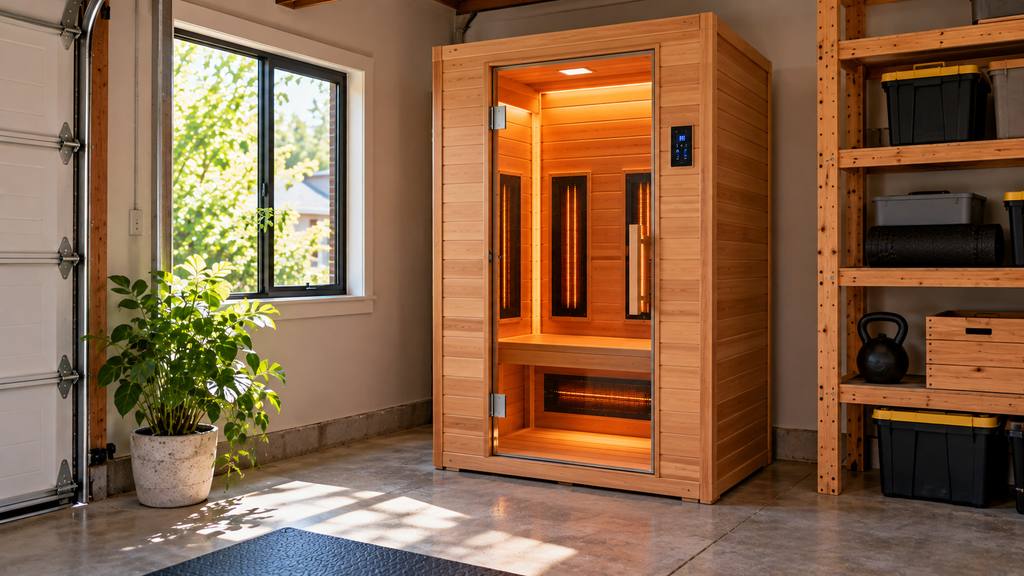
A freestanding sauna does not necessarily require converting the garage itself into conditioned living space. Prefabricated indoor sauna cabins are specifically designed to sit on existing hard floors.
But there are four separate questions to investigate.
Check Local Building Requirements
Building and electrical rules vary significantly by jurisdiction.
Installing a plug-in appliance is very different from:
- Adding a new 240V branch circuit
- Installing permanent wiring
- Adding plumbing or a floor drain
- Framing a new enclosed room
- Altering garage ventilation
- Modifying structural components
- Converting part of a garage to another legally defined use
Do not assume a project is permit-free simply because the sauna itself arrives as a kit.
Your local building department or licensed electrician can tell you what permits and inspections apply in your jurisdiction.
Check Your HOA
If your garage is controlled by a homeowners association, read the governing documents before ordering.
An indoor freestanding cabin may attract little attention, but rules can become more relevant if you modify ventilation, alter exterior walls, add visible electrical equipment, or use space in a way restricted by the association.
Detached garages and exterior barrel-sauna installations can involve additional architectural rules.
Get written approval when your HOA requires it. Even if the HOA does not explicitly prohibit a sauna, they may have rules about electrical work, exterior modifications, or noise that apply to your installation.
Renters Need Another Layer of Permission
A renter can potentially use a plug-in infrared sauna without making permanent alterations — but only with the property owner’s permission.
The problem begins when installation requires a new circuit.
Do not install a 240V circuit, modify the electrical panel, cut walls, install vents, or alter plumbing without the property owner’s authorization.
A 120V plug-in infrared sauna is therefore much easier to justify for a renter than a 6kW traditional heater requiring a hardwired 240V/30A circuit.
Do Not Block the Garage’s Normal Functions
Your sauna should not interfere with:
- Vehicle access
- Required exits
- Doors
- Electrical panels
- Water heaters
- HVAC equipment
- Fire-safety equipment
- Garage-door tracks and mechanisms
Also think about how the sauna door opens.
A cabin that technically fits between a wall and a parked car is not useful if you cannot comfortably enter it.
Garage-Specific Challenges
A garage solves the space problem, but creates several problems you may not encounter inside the house.
1. Temperature Swings
An attached insulated garage might stay relatively moderate.
An uninsulated detached garage in Minnesota or Arizona is a completely different environment.
Winter temperatures can dramatically increase warm-up time. High summer temperatures can also affect electronics and electrical equipment.
This matters especially with infrared saunas. Do not assume that an indoor-only infrared cabin is designed to sit indefinitely in freezing or highly humid conditions.
Golden Designs, for example, specifically lists the Dynamic Barcelona as indoor use only.
If your garage essentially behaves like an outdoor space in winter, verify the manufacturer’s acceptable installation environment before buying.
Should You Insulate the Entire Garage?
Usually not — just for the sauna. Insulating the garage can still improve comfort outside the sauna and reduce extreme temperature swings.
A well-insulated prefabricated sauna creates its own heated enclosure. Cedarbrook’s modular traditional saunas, for example, use insulated wall and ceiling panels rather than relying on the surrounding room to hold sauna temperatures.
But spending thousands of dollars finishing an entire two-car garage just to install a 4-by-4-foot sauna may be unnecessary.
2. Moisture
A traditional sauna is not the same as a steam room.
You typically add relatively small amounts of water to heated sauna stones rather than continuously filling the enclosure with steam. Almost Heaven says water can be added to properly heated stones in small quantities.
Still, people sweat, water can spill, and humid air escapes whenever you open the sauna door.
A damp garage with poor airflow can develop:
- Condensation
- Mold
- Musty odors
- Corrosion
- Wood deterioration
Solve an existing garage moisture problem before adding another source of humidity
3. Ventilation
Follow the sauna manufacturer’s ventilation instructions first.
Do not improvise by sealing every opening because you think that will make the sauna hotter. Proper sauna ventilation contributes to air quality and allows the heater and controls to operate as designed.
You also want the garage itself to dry after sessions.
That may mean ordinary garage ventilation, a dehumidifier in humid climates, or another building-appropriate ventilation strategy.
The sauna’s internal vent and the garage’s overall moisture management are two different issues.
4. Dust and Garage Contaminants
Garages collect things you do not want around a hot relaxation space — sawdust, automotive fluids, gasoline, paint, solvents, fertilizers, pesticides, and exhaust residue.
Do not place the sauna next to flammable materials. And never run a vehicle in an enclosed garage while occupying the sauna, because a cabin is not protection from carbon monoxide.
5. Pest Control
Detached garages are particularly vulnerable to insects and rodents.
Inspect the proposed sauna area before assembly. Seal appropriate gaps in the garage structure, remove food sources, and avoid creating inaccessible piles of cardboard behind the sauna.
Leave enough room around the cabin to inspect and clean where the manufacturer allows.
You do not want to discover mouse activity behind a 400-pound sauna six months after installation.
Electrical Requirements: 120V vs. 240V
Electrical planning is the part of a garage sauna project where beginners most often underestimate the work.
There are two broad categories.
120V Infrared Saunas
Small infrared cabins can be remarkably simple.
The Dynamic Barcelona, for example, uses 120V/15A electrical service and Golden Designs recommends a dedicated outlet.
That can eliminate the expense of installing a large 240V circuit.
But “120V” does not mean you should simply use whichever garage receptacle is closest.
Garages often have refrigerators, freezers, power tools, battery chargers, door openers, compressors, and other loads.
Confirm the circuit requirements in the sauna manual and have the existing circuit checked if you are uncertain about what else it supplies. A 15A circuit is quickly overloaded. If the garage outlet shares a circuit with a refrigerator or freezer, the sauna may trip the breaker even though the sauna itself is rated correctly.
Do not use an extension cord or power strip unless the manufacturer explicitly permits it.
For the full electrical planning picture — including 120V vs 240V, panel capacity, and dedicated circuit requirements — see our guide to whether a home sauna needs a dedicated circuit.
240V Traditional Saunas
Traditional electric heaters generally require substantially more power.
Almost Heaven states that its traditional heaters use hardwired 240V electrical service. Its current guidance specifies 30A service for its 4.5kW and 6kW heaters, with larger heaters potentially requiring 40A service. Exact requirements depend on the heater and installation.
The Salem barrel sauna, for example, currently comes with a 6kW, 240V heater requiring 30A service and a hardwired connection. Its lighting separately uses 110/120V 15A plug-in service.
For most homeowners, this is licensed-electrician territory.
Your Panel Location Matters
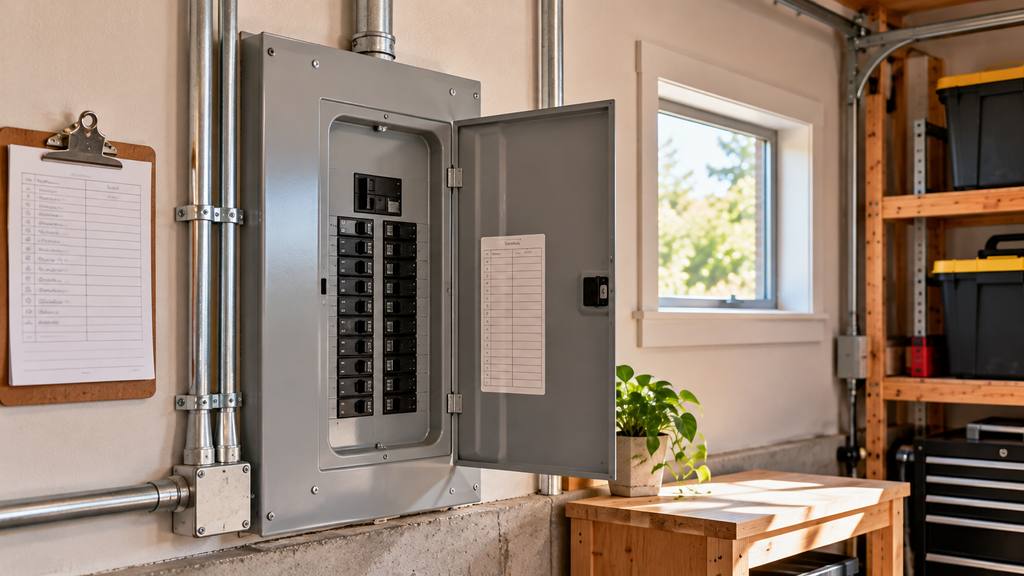
A garage can actually be one of the cheapest places to install a 240V sauna if the main or subpanel is nearby and has adequate capacity.
Even if the panel is nearby, it must have two open breaker slots and enough total capacity to handle the new circuit alongside everything else already drawing power.
If the electrician must run cable across a finished house, through an attic, underground to a detached garage, or upgrade a full panel, the price can rise substantially.
Have the electrical situation evaluated before ordering the sauna.
What About GFCI Protection?
This is one area where generic internet advice can cause trouble.
GFCI requirements depend on the equipment, wiring method, applicable electrical-code edition, local amendments, installation location, and manufacturer’s listing/instructions. The National Electrical Code has expanded GFCI requirements over successive editions, including appliance-specific protection requirements.
At the same time, some sauna manufacturers specify particular circuit configurations for their equipment. Golden Designs, for example, currently describes the Barcelona connection as a 120V/15A non-GFCI plug-and-play installation.
Do not resolve that apparent conflict by guessing or bypassing protection.
Have a licensed electrician determine what is required by the adopted local code and the sauna’s listing and installation instructions. If the two appear incompatible, resolve that with the manufacturer and authority having jurisdiction before installation.
Do You Need a Permit?
Possibly.
A new hardwired 240V circuit commonly falls within electrical permitting requirements, but rules and homeowner-permit allowances differ across US jurisdictions.
Ask your local building department or electrician.
In most US jurisdictions, adding a new 240V circuit requires both a permit and a final inspection.
A permit is a small inconvenience compared with discovering during a home sale, insurance claim, or later renovation that a high-current circuit was installed improperly.
Unpermitted electrical work can also void homeowner’s insurance coverage if an electrical fire occurs, and it must often be disclosed when selling the home.
Flooring and Drainage Options
Garages have one major advantage over bedrooms: concrete.
Almost Heaven specifically notes that an unfinished basement or garage with concrete flooring is an easy location for an indoor sauna.
Option 1: Existing Concrete Slab
For many prefabricated saunas, this is the simplest option.
Make sure the slab is:
- Structurally sound
- Dry
- Reasonably level
- Clean
- Free of major cracks or standing water
Check the manufacturer’s base requirements before assembly.
A removable sauna mat or manufacturer-approved floor insert can make the interior more comfortable.
Option 2: Tile
Tile is another practical sauna-area surface because it handles moisture well and is easy to clean.
For a custom installation, proper waterproofing beneath the tile matters more than the appearance of the tile itself.
Option 3: Waterproof or Water-Resistant Vinyl
Some indoor sauna manufacturers permit installation on appropriate hard flooring. Almost Heaven discusses waterproof or water-resistant luxury vinyl and sheet vinyl as possible indoor sauna-floor options.
Check your specific sauna manufacturer before covering the garage slab.
Avoid Carpet
Carpet is a poor choice underneath or immediately around a traditional sauna.
It holds moisture and is difficult to sanitize. Most sauna installation guides recommend easily cleaned surfaces such as concrete, ceramic tile, or poured flooring, and specifically advise against carpet in the sauna environment.
What About a Wood Floor?
Solid wood or engineered wood flooring is generally not recommended directly under a sauna. Even if the sauna itself is designed to be dry, spills, sweat, and humidity can damage wood over time. If you want a warmer floor under your sauna, use a removable wood or bamboo sauna mat instead of permanent wood flooring.
Do You Need a Floor Drain?
Not necessarily.
A prefab dry/traditional sauna is not a shower.
Cedarbrook states that its freestanding indoor modular sauna kits can be installed on a non-permeable hard floor without a floor drain.
A drain is still useful when you are building a custom sauna that will be washed frequently or when your design intentionally uses more water.
If your garage already has drainage, verify where that drain actually goes and whether using it for your intended purpose is appropriate under local requirements.
Do not cut into the slab to install plumbing until you know you actually need it.
Which Type of Sauna Works Best in a Garage?
You have four realistic choices.
| Sauna Type | Typical Price | Electrical Requirement | Best For |
| Infrared Cabin | $1,500–$4,000 | 120V/15A (some models) | Easy installation |
| Traditional Cabin | $3,000–$8,000+ | 240V hardwired | A real sauna experience |
| Barrel Sauna | $4,000–$8,000+ | 240V hardwired | Detached garages |
| Custom Built-In | $10,000+ | 240V hardwired | Permanent renovations |
Infrared Sauna
Best for: Easy installation and lower electrical requirements.
Infrared cabins heat the user primarily through radiant energy rather than relying on a high-temperature room and sauna stones.
For a detailed comparison of infrared saunas designed for small spaces, see our guide to the 5 best infrared saunas for apartments.
Compact models commonly operate around 120-140°F, depending on the manufacturer. Golden Designs lists the Barcelona’s normal range at approximately 118-132°F with capability up to 140°F.
The biggest garage advantage is electricity. Some small models run on 120V/15A service.
For a compact alternative that works in small spaces, see our guide to infrared sauna blankets for small spaces.
If you want to build a custom infrared sauna in your garage, see our guide to the best infrared sauna heaters for small spaces.
Traditional Cabin Sauna
Best for: Buyers who want a conventional hot sauna indoors.
A traditional cabin uses an electric heater and stones. Expect temperatures considerably higher than an infrared cabin and expect a 240V hardwired heater in most residential US installations.
Almost Heaven says its traditional heaters reach at least 170°F, depending on configuration.
This is the option I would prioritize if the garage is permanent and you are willing to pay for electrical installation.
Barrel Sauna
Best for: Large or detached garages with plenty of open floor area.
Barrel saunas are space-efficient internally and visually simple, but do not assume “barrel” means small.
The two-person Almost Heaven Salem is approximately 78 inches wide and 47 inches deep.
Check ceiling clearance as well as the door and assembly route.
Custom Built-In Sauna
Best for: Permanent renovations.
A custom sauna gives you control over insulation, bench height, ventilation, lighting, and room dimensions.
It is also the easiest way to turn a simple garage sauna into a construction project.
Unless you specifically want a built-in room, beginners are generally better served by a modular or prefabricated cabin.
If you are unsure which type fits your situation, start with the electrical question. Your panel capacity and garage wiring will eliminate two or three of these options immediately.
Step-by-Step: How to Set Up a Sauna in Your Garage
Step 1: Decide Exactly Where It Will Go
Park your vehicles first.
Then mark the sauna footprint on the floor with painter’s tape.
Do not just measure width and depth. Account for:
- Door swing
- Ceiling height
- Manufacturer-required clearances
- Electrical access
- Garage-door tracks
- Storage
- Walking space
- Heater servicing
- Ventilation
- Assembly space
A sauna that fits on paper can still be impossible to assemble against a wall.
Step 2: Check the Garage Environment
Look for evidence of:
- Water intrusion
- Condensation
- Mold
- Pest activity
- Major slab cracks
- Roof leaks
- Standing water
Fix those problems first.
If the garage becomes extremely cold in winter, check the sauna manufacturer’s environmental restrictions.
Step 3: Confirm Rules and Permissions
Homeowners should check applicable building, electrical, and HOA requirements.
Renters should get the owner’s permission before making permanent changes.
Do this before spending thousands of dollars on equipment.
Step 4: Have the Electrical Load Evaluated
Give the electrician the actual sauna/heater installation manual, not simply a statement that you “need a sauna outlet.”
The electrician needs to know:
- Voltage
- Heater wattage/kW
- Required amperage
- Connection type
- Circuit requirements
- Control requirements
- Lighting requirements
- Manufacturer instructions
For a traditional heater, this usually means planning a dedicated 240V circuit.
Step 5: Prepare and Level the Floor
Clean the slab thoroughly.
Check level across the entire sauna footprint.
Correct significant problems according to the sauna manufacturer’s installation requirements rather than using random wood scraps as shims.
If you are installing finished flooring, complete that work before assembling the sauna.
Step 6: Create a Clean Sauna Zone
Move paint, gasoline, solvents, lawn chemicals, and similar products away from the installation.
Give yourself enough room to clean around the sauna.
This is also a good time to improve lighting in that part of the garage.
Once your garage sauna is set up, see our guides to the best sauna accessories and the best sauna thermometers for small home saunas.
If you are outfitting your new garage sauna, see our guide to the best sauna accessories for small home saunas.
For accurate temperature and humidity readings during your first sessions, see our guide to sauna thermometers and hygrometers.
For sauna accessories that improve the experience without taking up space, see our guide to the best sauna accessories for small home saunas.
For a closet instead of a garage, see our guide to converting a closet into a small sauna room.
Step 7: Assemble the Cabin
Follow the manual in order.
Do not assume all sauna kits assemble the same way.
Prefabricated infrared cabins can use interlocking or clasp-together wall panels. The Dynamic Barcelona, for example, uses clasp-together construction.
Larger modular traditional cabins may require two people simply because of panel weight.Some modular traditional cabin panels can weigh more than 125 pounds each.
Leave electrical connections to the appropriate professional when required.
A common observation from owner reviews is that labeling the panels as you unbox them saves significant time during assembly, especially for modular traditional cabins with more than a dozen individual wall and ceiling pieces.
Step 8: Install the Heater and Controls
For a traditional sauna, heater positioning is not a matter of preference.
Follow the heater manufacturer’s minimum clearances, mounting height, guard requirements, sensor placement, and stone-loading instructions exactly.
Never move a heater closer to wood because you want additional bench space.
Step 9: Test Before the First Full Session
Before sitting inside for an hour, check:
- Door operation
- Heater operation
- Controls
- Lighting
- Ventilation
- Unusual smells
- Breaker behavior
- Loose fasteners
- Water leaks where relevant
A new traditional sauna may also require an initial heat cycle according to manufacturer instructions.
Follow the manual.
From arrival of the sauna to the first full session, most homeowners should plan for 2–4 weeks of elapsed time — one weekend for preparation, 1–2 days for assembly, and time for electrical work and inspection.
How Much Does a Garage Sauna Cost?
Your budget depends more on sauna type and electrical work than on the garage itself.
As a broad US benchmark, Angi currently places many home-sauna projects around $2,500–$7,000, with custom installations capable of exceeding $10,000.
A garage installation can be cheaper when you already have a usable slab and nearby electrical panel.
| Expense | Practical planning range |
| Compact infrared cabin | Roughly $1,500–$4,000 |
| Prefab traditional sauna | Roughly $3,000–$8,000+ |
| Larger/premium sauna | $5,000–$10,000+ |
| Typical sauna electrical work | Around $300–$800 as a broad benchmark |
| More complex electrical/panel work | Can exceed $1,000 |
| Professional sauna installation | Varies widely; complex installations can reach several thousand dollars |
| Flooring | $0 if suitable concrete already exists; more if finishing is required |
| Permit | Varies by municipality |
| Garage insulation/moisture work | $0 to several thousand dollars depending on existing condition |
Current national cost guides put typical sauna electrical work around $300–$800, although a long cable run, panel upgrade, detached-garage feeder, or other complications can push the project substantially higher.
Do not budget from a generic “240V outlet” quote alone. A sauna heater may be hardwired and has manufacturer-specific circuit requirements.
Homeowners in high-cost-of-living states frequently report electrical work closer to the $1,000–$1,500 range, especially when a panel upgrade or a long wire run to a detached garage is required. The national averages mask significant regional variation.
For a deeper breakdown of electricity costs by state and model, see our complete running cost guide.
Monthly Running Cost
You can estimate electricity with:
Heater kW × operating hours × electricity price per kWh
Suppose you have a 6kW traditional heater and run it for an average of 1.25 hours per session, including warm-up.
At four sessions per week:
6 kW × 1.25 hours × 4 × 4.33 weeks = about 130 kWh/month
At an illustrative electricity price of $0.18/kWh:
130 × $0.18 = about $23/month
That is a conservative full-rated-power calculation. Actual consumption can differ because heaters may cycle rather than draw full rated power continuously.
A smaller infrared sauna generally uses much less power.
If a roughly 1.5kW infrared cabin operates for one hour, four times per week:
1.5 × 1 × 4 × 4.33 = about 26 kWh/month
At $0.18/kWh, that is roughly $4.70 per month.
Your actual electricity rate, garage temperature, sauna insulation, warm-up time, heater size, and usage frequency determine the real number.
If you plan to add a cold plunge next to your garage sauna, running a chiller typically costs an additional $8–$15 per month depending on climate and usage.
If you only use your sauna in winter, your monthly average will be lower than if you use it year-round. Many homeowners keep the sauna on a separate circuit and simply turn the breaker off between seasons.
Common Mistakes to Avoid When Installing a Sauna in a Garage
Mistake 1: Buying Before Checking the Electrical Panel
A $4,000 sauna is not useful if your panel cannot support its heater without $1,000+ in additional electrical work.
Get electrical requirements first.
Mistake 2: Assuming Every 120V Sauna Uses Any Normal Outlet
Some 120V infrared cabins use 15A service; others can require 20A service.
Voltage alone does not tell you whether your existing outlet is appropriate.
Mistake 3: Ignoring Winter Garage Temperatures
A sauna may eventually get hot in a cold garage, but that does not mean the equipment is approved for storage and operation at every ambient temperature.
Check the manufacturer’s limits.
Mistake 4: Putting the Sauna Against a Wet Wall
If the bottom of your drywall is already stained or the slab gets wet after storms, solve the water problem first.
A sauna does not improve a damp garage.
Mistake 5: Treating a Traditional Sauna Like a Steam Room
Pouring excessive water over an electric heater creates unnecessary moisture and may damage equipment.
Follow the heater manufacturer’s instructions for water use.
Mistake 6: Storing Chemicals Beside the Sauna
Your sauna corner should not double as storage for gasoline cans, paint thinner, pesticides, or propane cylinders.
Create separation between the relaxation area and ordinary garage hazards.
Mistake 7: Forgetting Assembly Clearance
A 39-inch-wide cabin does not necessarily assemble inside a 40-inch-wide opening.
You may need to stand panels upright, reach fasteners, install roof sections, and access the rear of the cabin during assembly.
Mistake 8: DIYing Electrical Work Beyond Your Ability
A hardwired 240V sauna heater is not the place to learn residential electrical work from videos.
Use a qualified electrician where required.
Mistake 9: Forgetting to Plan for Ventilation
A sealed garage traps heat, moisture, and any exhaust or chemical vapors. Before installing the sauna, confirm that the garage itself has adequate airflow to dry out after each session. In humid climates, a small dehumidifier near the sauna area is often worth the extra $150–$300.
FAQ
Can I put a sauna directly on a concrete garage floor?
For many prefabricated models, yes.
Almost Heaven specifically identifies concrete garage flooring as a straightforward surface for an indoor sauna, while Cedarbrook lists cement slabs as suitable bases for its modular indoor cabins.
The slab should be level, dry, stable, and compatible with your specific sauna’s installation instructions.
Do I need to insulate my garage before installing a sauna?
Not necessarily.
A properly designed freestanding sauna has its own enclosure, and insulated modular traditional saunas are designed to retain heat internally.
Garage insulation becomes more important in extreme climates or when you want the entire garage to be comfortable.
Always check the sauna’s permitted ambient operating conditions.
Does a garage sauna need a floor drain?
Many residential prefab saunas do not.
According to Cedarbrook’s product documentation, a floor drain is not required for its indoor modular kits when installed on suitable non-permeable hard flooring.
Custom wet-use designs may benefit from drainage, so follow the requirements of your particular design.
Can I run a sauna from a normal garage outlet?
Some infrared saunas, yes.
The Dynamic Barcelona uses 120V/15A service and Golden Designs recommends a dedicated outlet.
Traditional electric sauna heaters normally require much more power. The 6kW heater supplied with the Almost Heaven Salem, for example, requires a hardwired 240V/30A connection.
Will a sauna make my garage moldy?
A properly installed and managed sauna should not automatically create a mold problem, but moisture still needs somewhere to go.
Traditional sauna use releases some humidity when water is placed on stones and when the door opens after a session.
Maintain garage ventilation, allow the sauna to dry, and address existing moisture problems before installation.
Can I install a garage sauna if I rent?
Possibly, particularly a freestanding plug-in infrared model.
But do not add circuits, alter walls, install permanent ventilation, or make other modifications without the property owner’s permission.
A portable 120V cabin is generally a much more renter-friendly project than a permanently wired traditional sauna.
How much space should I leave around a garage sauna?
Use the manufacturer’s specified clearances.
Do not create a generic clearance rule and assume it applies to every sauna.
You also need practical service and assembly space even when the manufacturer’s minimum clearance is small.
Measure garage-door hardware overhead as well.
Can I put a cold plunge next to my garage sauna?
Potentially, and a garage is often more practical than an apartment for the combination.
But a cold plunge introduces a much larger quantity of water, additional drainage requirements, and potentially a powered chiller. Keep electrical equipment appropriately separated from water and follow applicable installation requirements.
For small-space plunge options, see our guide to The 3 Best Small Cold Plunges for Apartments, Showers, and Balconies.
For a full garage installation walkthrough, see our complete guide to setting up a cold plunge in a garage.
Can I use a sauna in a garage that has no insulation?
Yes, but it is not ideal in extreme climates. The sauna itself is insulated, but an uninsulated garage makes warm-up slower in winter and increases stress on the heater. In mild climates, an uninsulated garage works fine. In Minnesota or Arizona, consider at least insulating the sauna area or the entire garage.
How long does a garage sauna installation take?
Plan for 2–4 weeks of total elapsed time. One weekend for preparation and floor work, 1–2 days for assembly, plus time for the electrical work and any permit inspection. The sauna panel assembly itself is usually the fastest part of the project.
If you want to add cold therapy to your recovery setup, see our guide to cold plunge vs ice bath.
Final Recommendations: Three Garage Saunas to Consider
There is no single best garage sauna because the right choice depends mainly on your electrical capacity and how permanent you want the installation to be.
These three real models cover the most useful garage scenarios.
1. Dynamic Barcelona DYN-6106-01 — Best for the Easiest Garage Setup
Choose the Barcelona if your priority is avoiding 240V electrical work.
Golden Designs lists the current model at:
- 39″W × 36″D × 73″H
- 250 pounds
- 120V/15A electrical service
- Dedicated outlet recommended
- Six far-infrared carbon heating panels
- Up to 140°F
- Canadian hemlock construction
- Indoor use only
The current manufacturer list price is around $3,499, although retailer pricing and promotions can vary significantly.
The biggest caveat is the indoor-use designation. I would use this only in a garage that stays dry and remains within the environmental conditions required by the manufacturer.
For an attached garage and a homeowner who does not care about sauna stones or 180°F-plus temperatures, this is the simplest of the three.
Owners on sauna forums frequently mention that the Barcelona’s warm-up time in an unheated garage is around 25–30 minutes in mild weather, but can extend to 45 minutes or more in a cold garage. If you plan to use it in winter, factor that into your routine.
Pros
- Compact footprint
- 120V/15A — no hardwired 240V needed
- Relatively easy assembly
- Fits in a standard garage corner
Cons
- Infrared rather than traditional heat
- Indoor-only designation
- 250-pound cabin
- Still requires a dedicated electrical circuit
2. Cedarbrook 4×4 Indoor Home Sauna Kit — Best Compact Traditional Garage Sauna
Cedarbrook 4×4 Indoor Home Sauna Kit
For a permanent garage setup where you want traditional heat, Cedarbrook’s 4×4 modular sauna is worth considering.
Cedarbrook lists a 4 × 4 × 6’4″ interior and includes a 4.5kW heater with the standard configuration. The company describes its modular cabins as insulated and suitable for assembly directly on hard surfaces including a cement slab.
The advantage over converting part of the garage yourself is that you get a purpose-built insulated sauna enclosure without framing, insulating, vapor-managing, and finishing an entire room from scratch.
Based on discussion threads from Cedarbrook owners, the initial assembly of a modular sauna takes two people roughly 4–6 hours. Budgeting a full weekend is safer than expecting a one-afternoon project.
Pros
- Traditional sauna experience with stones
- Compact 4-by-4-foot interior
- Insulated construction
- Garage-friendly concrete-slab installation
Cons
- More involved than a plug-in infrared cabin
- Requires appropriate electrical installation
- Higher total cost once electrical labor is included
For someone who owns the home and expects the sauna to remain in the garage for years, this is the configuration I would investigate first.
Cedarbrook 4×4 Indoor Home Sauna Kit
3. Almost Heaven Salem 2-Person Barrel Sauna — Best Barrel Option for a Large Garage
Almost Heaven Salem 2-Person Barrel Sauna
The Salem is a genuine two-person barrel sauna from Almost Heaven.
Current specifications include:
- 78″W × 47″D × 75⅜”H assembled dimensions
- 6kW heater
- 240V
- 30A heater circuit
- Hardwired heater connection
- Separate 110/120V 15A lighting connection
- 1⅜-inch ball-and-socket lumber
- Sauna stones included
Almost Heaven currently lists configurations starting around $4,000, with price varying substantially according to wood, door/window, and heater selection.
The Salem needs more width than a compact cabin, so measure carefully. But in a detached two-car garage, workshop, or oversized single-car garage, its roughly 6½-foot width can be workable.
Almost Heaven’s customer reviews consistently praise the build quality, but a common complaint is the 30-day lead time on some configurations. If you want the Salem, order it before your electrical work is scheduled so the timing aligns.
Pros
- Traditional stone-heater experience
- Compact two-person barrel design
- Established US sauna manufacturer
- Several heater configurations available
Cons
- Requires 240V/30A hardwired service
- Much wider than a vertical cabin
- More installation planning than a plug-in infrared sauna
Almost Heaven Salem 2-Person Barrel Sauna
This post contains affiliate links. If you buy through them, we may earn a commission at no extra cost to you.