Disclosure: This article contains affiliate links, including links to products sold through Amazon Associates. We may earn a commission from qualifying purchases at no extra cost to you.
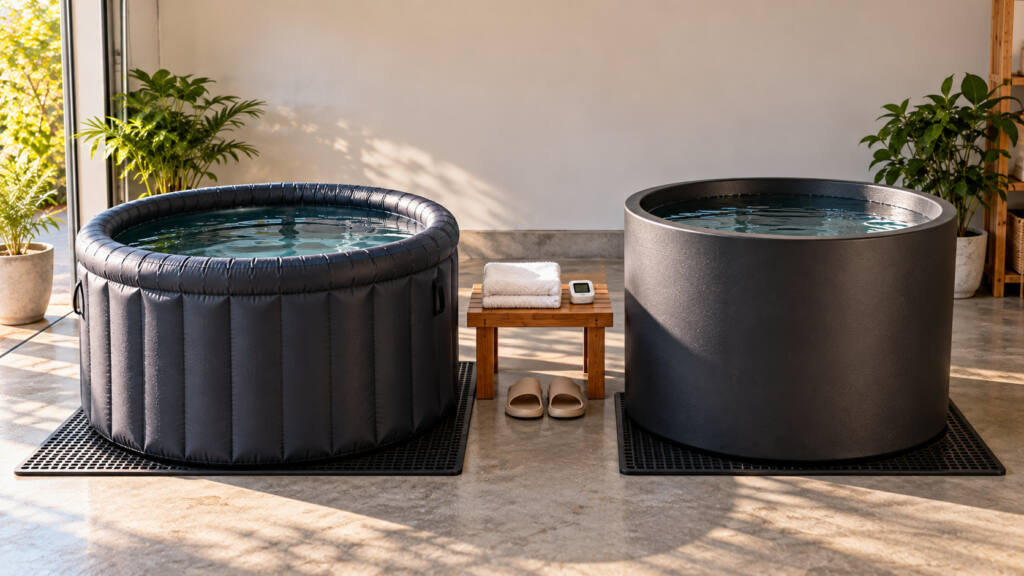
The inflatable vs hard-shell cold plunge decision comes down to how much space you have, how often you move, and whether you want a portable tub or a permanent part of your home.
For apartment dwellers, the choice is more complicated than comparing prices. A cold plunge that works well in a garage may be completely impractical in a second-floor apartment. A lightweight inflatable tub may fit into a shower, but that does not mean the floor can safely support it when filled.
Both types have advantages. Inflatable models are easier to transport, store, and replace. Hard-shell tubs generally offer more rigid construction, better resistance to everyday wear, and the potential for more effective insulation and integrated cooling.
Neither category automatically solves the biggest problems of small-space cold plunging: filled weight, drainage, water hygiene, and limited floor space.
This guide compares both options from the perspective of US renters and small-space homeowners. It covers real product examples, installation requirements, running costs, durability, and the situations where spending more on a hard-shell tub makes sense.
Bottom Line: Inflatable or Hard-Shell?
Choose an inflatable cold plunge if you rent, move every few years, have limited storage space, or want to try cold immersion without a large upfront investment. Choose a hard-shell cold plunge if you own your home, have a dedicated ground-level location, and want a more durable installation that stays assembled year-round. For most apartment renters, an inflatable or collapsible tub is the more practical starting point. A hard-shell model becomes more attractive when you have enough space, reliable drainage, and the budget for a long-term setup.
Quick Comparison: Inflatable vs. Hard-Shell Cold Plunge
| Feature | Inflatable cold plunge | Hard-shell cold plunge |
| Upfront cost | Typically around $80–$600+ for portable tubs | Commonly around $800–$5,000+, depending on construction and cooling |
| Filled weight | Hundreds to over 1,000 lb, depending on water volume | Hundreds to over 1,000 lb, depending on water volume |
| Durability | More vulnerable to punctures, seam damage, and air loss | Generally better resistance to punctures and everyday wear |
| Lifespan | Varies with materials, usage, and storage | Often longer, but construction and maintenance matter |
| Insulation | Ranges from basic flexible walls to insulated designs | Can offer thicker, more consistent insulation |
| Portability when drained | Usually easier to carry and transport | More difficult; may require two people or moving equipment |
| Storage footprint | Many can fold or pack into a bag | Usually retains full dimensions |
| Drainage complexity | Requires a drain valve, hose, or pump | Requires a drain valve, hose, or pump |
| Chiller compatibility | Available on selected models | Common on premium or chiller-ready models |
| Repairs | Patches, valve replacements, or component replacement where supported | Repairs may involve specialized materials or professional service |
| Best for | Renters, occasional use, limited storage | Homeowners, dedicated spaces, frequent use |
The most important point: A hard-shell tub is not automatically better insulated, and an inflatable tub is not automatically lightweight in use.
Actual performance depends on the specific product.
For a wider selection of compact tubs, see our guide to small cold plunges for apartments, showers, and balconies.
What Is an Inflatable Cold Plunge?
An inflatable cold plunge is a portable water-filled tub that uses air chambers, flexible walls, or a combination of inflatable and supporting components to create a bathing vessel.
Unlike a conventional bathtub, it does not require permanent installation.
Most portable models can be assembled in a bathroom, garage, or another suitable location and packed away after draining and drying.
However, the term inflatable cold plunge is often used broadly.
Some products have inflatable sidewalls. Others use insulated fabric walls supported by poles or rigid rings.
That distinction affects setup time, storage, puncture resistance, and stability.
How Inflatable Cold Plunges Are Constructed
Common materials include PVC, reinforced synthetic fabric, flexible waterproof liners, and inflatable air chambers.
A typical portable setup may include:
- A waterproof tub body
- Inflatable rings or structural supports
- A drain valve
- A removable cover
- A pump or inflation accessory
- A carrying bag
- Optional chiller connection ports
Insulation varies significantly.
A basic portable bathtub may have relatively thin walls, while a purpose-built cold plunge can use multiple material layers to reduce heat transfer.
Real Inflatable Cold Plunge Examples
The Pod Company Ice Pod Pro
The Pod Company Ice Pod Pro is a useful example of a portable insulated plunge.
Its advertised specifications include:
- 32-inch diameter
- 30-inch height
- 110-gallon capacity
- Double-layer insulation
- Compatibility with suitable chillers
- Accommodation for users up to approximately 6’7″
Its relatively compact round footprint is attractive for smaller spaces.
However, at 110 gallons, the water alone weighs approximately 917 pounds. That makes structural support an important consideration even though the tub itself is portable.
VEVOR Cold Plunge Tub
VEVOR offers an inflatable oval cold plunge approximately 59 inches long and 31.5 inches wide.
The model is advertised with a capacity of approximately 216 gallons and includes an insulated lid, pump, carry bag, repair kit, and chiller connection ports.
Its main advantage is a longer soaking position.
Its disadvantage for apartment use is the considerable footprint and potential water weight.
AudaciaGo XXL Ice Bath Tub
The AudaciaGo XXL is another inflatable oval design, approximately 59 inches long and 31.5 inches wide.
Its advertised 216-gallon capacity is substantial.
The product includes several accessories, including a pump, thermometer, absorbent mat, repair kit, and insulated lid.
It is better suited to a spacious, structurally appropriate ground-level location than a typical upstairs apartment.
Owners who regularly deflate and store portable tubs often have to account for drying time as well as setup time, so choose a model you can clean and dry completely before packing it away.
The Main Appeal
The biggest advantage of an inflatable cold plunge is flexibility.
You can start with an inexpensive ice-only setup, determine whether you enjoy cold immersion, and upgrade later.
You do not need to dedicate a permanent corner of your home to a rigid tub.
That flexibility is especially useful for renters.
For more portable options, see our guide to the best inflatable cold plunges for apartments.
What Is a Hard-Shell Cold Plunge?
A hard-shell cold plunge uses a rigid tub body rather than flexible inflatable walls.
Common construction materials include rotomolded polyethylene, acrylic, and fiberglass-reinforced materials.
Some models have insulated walls, integrated seating, molded steps, or built-in connections for refrigeration and filtration.
Unlike most inflatables, a hard-shell tub generally retains its full size even when empty.
That makes it more difficult to transport and store.
Rotomolded Plastic
Rotomolded polyethylene is commonly used for durable outdoor equipment.
The manufacturing process creates a rigid molded shell that can resist impacts and everyday wear.
The thickness, insulation, and overall construction vary by manufacturer.
Acrylic and Fiberglass
Acrylic and fiberglass construction is more common in premium bathing and spa products.
These materials can provide a smooth finished surface and a more furniture-like appearance.
However, repairs may be more specialized than patching a flexible inflatable wall.
Real Hard-Shell Cold Plunge Examples
Ice Barrel 300
The Ice Barrel 300 is a rigid, insulated cold plunge with rotomolded construction.
Its advertised specifications include:
- Dimensions: approximately 35.5″ × 35.5″ × 30.5″
- Water capacity: approximately 77 gallons
- Empty weight: approximately 61 pounds
- Filled weight: around 700 pounds
- Insulated construction
- Chiller-ready connections
Its compact footprint is useful for homeowners with limited space.
However, its rigid construction means it cannot fold away when not in use.
Plunge Air
The Plunge Air is another example of a more permanent cold-plunge setup.
Its advertised dimensions are approximately 61″ × 32″ × 28″, with a capacity around 105 gallons.
The specified configuration includes a chiller, and the complete filled setup is listed at approximately 1,150 pounds.
That is a substantial installation for a small home.
It is more appropriate for a dedicated ground-level space than a typical apartment bathroom.
Owners who leave rigid tubs installed year-round often find that everyday access is more convenient than repeated assembly, so a hard-shell model makes the most sense when the tub can remain in one suitable location.
The Main Appeal
A hard-shell plunge is designed to remain assembled.
You do not need to inflate it before use or fold it away afterward.
Its rigid construction may also provide a more stable feeling when entering and exiting.
For frequent users with dedicated space, that convenience can justify the higher initial cost.
Where Inflatable Cold Plunges Win
Inflatable models have several advantages that matter particularly in apartments.
1. Lower Upfront Cost
Portable cold plunge tubs are generally less expensive than premium hard-shell systems.
A basic inflatable or collapsible tub may cost around $80–$300, while more substantial insulated models can cost several hundred dollars.
Hard-shell systems commonly require a much larger initial investment.
For someone trying cold plunging for the first time, spending less reduces the financial commitment.
2. Easier to Move
An empty inflatable tub can often be carried by one adult.
A rigid tub may require two people, a dolly, or professional moving assistance depending on its weight and dimensions.
If you move apartments every year or two, portability matters.
3. Smaller Storage Footprint
Many inflatable models can be deflated, folded, and stored in a closet.
Hard-shell tubs retain their full dimensions.
This is a significant difference if your apartment has no dedicated recovery area.
4. More Renter-Friendly
An ice-only inflatable tub generally requires no permanent plumbing or electrical work.
You can fill it from an existing faucet and drain it through a suitable hose.
You still need landlord permission where required, and the floor must safely support the complete load.
Portable does not mean automatically approved.
5. Easier to Replace
If a lower-cost inflatable tub becomes damaged beyond repair, replacing the entire unit may be more practical than paying for a specialized repair.
That does not make inflatable tubs disposable products, but it can reduce the financial consequences of damage.
6. Good for Testing a New Routine
Many people buy a cold plunge before knowing whether they will use it consistently.
Starting with an inflatable allows you to test your routine, preferred water temperature, and maintenance requirements.
If you eventually decide to upgrade, you will have a better understanding of what you need.
Where Hard-Shell Cold Plunges Win
Hard-shell tubs become more attractive when you have a stable living situation and enough room for a permanent installation.
1. Better Resistance to Physical Damage
Rigid shells are generally less vulnerable to punctures than inflatable walls.
They can also tolerate routine contact with towels, covers, and cleaning equipment without the same risk of air loss.
However, rigid materials can still crack, scratch, or suffer damage.
2. More Consistent Shape and Stability
A hard-shell tub maintains its structure without inflation.
That can make the entry and exit experience feel more predictable.
For frequent use, this may be more convenient than checking air pressure or support components.
3. Potentially Better Insulation
A well-insulated hard-shell tub can reduce heat gain and help maintain cold water temperatures.
However, the category alone does not guarantee better performance.
A high-quality insulated inflatable may outperform a poorly insulated rigid tub.
Compare actual insulation design, cover quality, and manufacturer performance information.
4. Better Fit for a Permanent Setup
Hard-shell tubs often look more integrated into a garage, patio, or dedicated wellness room.
They can be easier to incorporate into a fixed layout with nearby storage, drainage, and electrical connections.
5. More Convenient Chiller Integration
Many premium hard-shell models are designed around compatible chillers, pumps, and filtration systems.
Some packages include refrigeration equipment.
That can simplify planning compared with adapting a portable tub.
Still, check what is actually included. A chiller-ready tub is not the same as a complete refrigerated system.
6. Potential Long-Term Value
If you use your plunge frequently for several years, a durable hard-shell model may justify its higher purchase price.
But long-term value depends on more than the tub.
Electricity, filtration, sanitation, repairs, and equipment replacement all affect ownership costs.
The Trade-Offs Neither Side Solves
Some of the biggest apartment-specific problems apply equally to inflatable and hard-shell tubs.
Filled Weight
Water is heavy regardless of the tub’s construction.
One US gallon weighs approximately 8.34 pounds.
| Water volume | Water weight alone |
| 40 gallons | 334 lb |
| 50 gallons | 417 lb |
| 77 gallons | 642 lb |
| 80 gallons | 667 lb |
| 100 gallons | 834 lb |
| 110 gallons | 917 lb |
| 216 gallons | 1,801 lb |
Add the empty tub, occupant, and equipment.
A portable tub that weighs 20 pounds empty can exceed 900 pounds when filled and occupied.
A hard-shell model may be heavier when empty, but the water is often the dominant part of the total load.
Owners who move or reposition tubs frequently may underestimate how much the filled weight changes the installation, so calculate the complete occupied load before choosing the location.
To estimate the complete occupied load for your specific setup, use our cold plunge weight calculator.
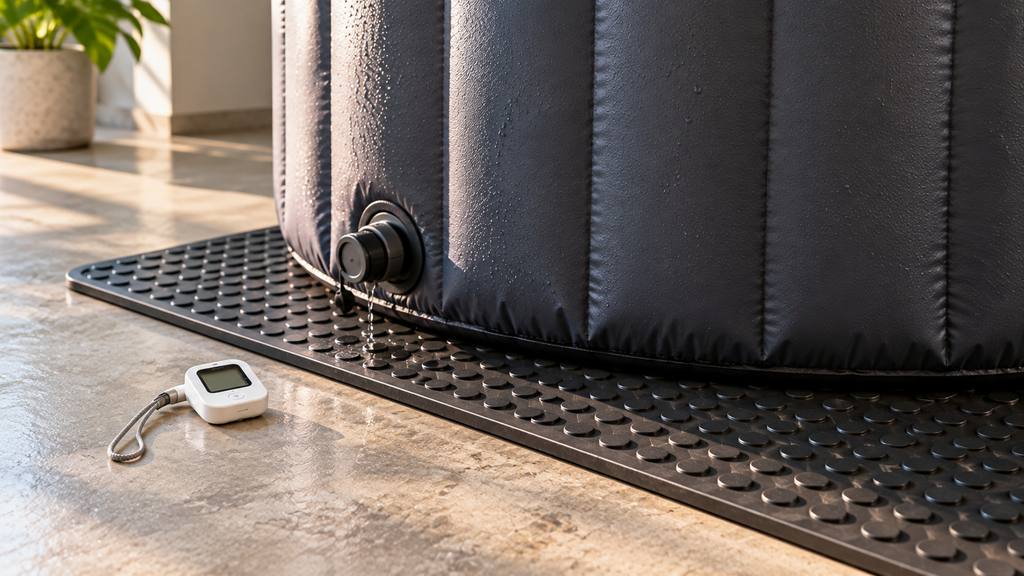
Do not assume an upstairs floor, balcony, or shower pan is suitable based on appearance or a generic residential floor-load figure.
When the structure is uncertain, obtain professional assessment.
Drainage
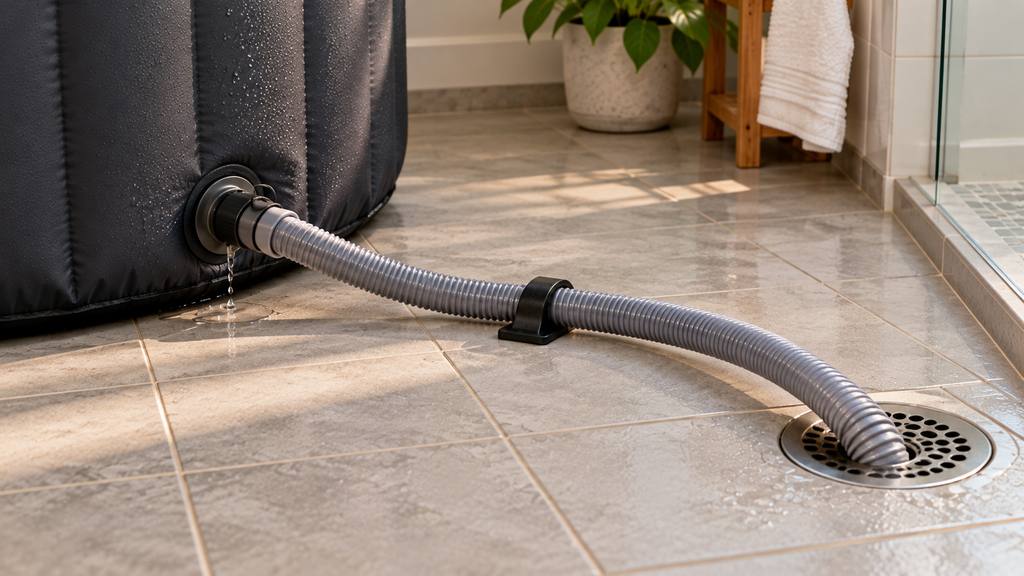
Both categories need a safe way to empty water.
A drain valve is helpful, but the water still needs an approved destination.
If gravity drainage is not possible, a suitable transfer pump may be required.
Never drain a plunge over a balcony railing or allow water to flow into neighboring units.
Hygiene
Cold water does not remain sanitary automatically.
Both inflatable and hard-shell tubs need cleaning and an appropriate water-management routine.
Filtration removes particles, but it does not necessarily disinfect the water.
Follow the manufacturer’s sanitation instructions.
Floor Space
A hard-shell tub may be permanent, but an inflatable tub still occupies real floor area while in use.
Measure the tub and allow clearance for entering, exiting, cleaning, and draining.
Do not block a bathroom door or required exit route.
Electrical Safety
Ice-only tubs need no powered refrigeration.
A chiller-equipped setup requires appropriate electrical protection, safe wiring, and adequate circuit capacity.
Many compact chillers operate on standard 120V power, but some larger systems have different requirements.
Do not use ordinary extension cords near standing water.
Monthly Running Costs
Both categories can be cooled with ice or compatible refrigeration, depending on the model.
For illustration, suppose you buy 20 pounds of ice per session, four times weekly.
At $0.20–$0.35 per pound, approximately 17 sessions per month would cost $68–$119.
A chiller may reduce ice purchases but adds electricity and maintenance.
For example, a 300W compressor running four hours per day uses approximately 36 kWh per month. At $0.18/kWh, that costs $6.48, excluding circulation-pump electricity.
Actual costs depend on water volume, insulation, room temperature, equipment efficiency, and usage.
For refrigeration options, see our guides to cold plunge chillers under $1,000 and cold plunge chillers under $1,500.
Which One Is Right for Your Apartment?
The best choice depends on how you live and where the tub will go.
Renter Who Moves Every 1–2 Years: Choose Inflatable
If you expect to move regularly, an inflatable is usually more practical.
It is easier to transport and does not require a dedicated permanent space.
Choose a model that packs down easily and has a straightforward drainage system.
To see specific models that fit this exact scenario, see our best cold plunge for renters.
Homeowner With Dedicated Space: Choose Hard-Shell
If you own your home and have a suitable ground-level area, a hard-shell tub becomes more attractive.
You can design the space around the tub, including drainage, electrical connections, and equipment access.
A rigid insulated model may provide a more convenient long-term setup.
Small Shower Only: Choose a Compact Portable Tub
If your only available location is a small shower, a compact inflatable or collapsible tub is usually more realistic.
The Homefilos Portable Bathtub is an example of a smaller round option.
The Ice Pod Pro may suit taller users, although its greater height and capacity require additional planning.
Confirm that the shower pan and supporting structure can safely handle the complete occupied load.
Garage or Ground-Level Patio: Consider Hard-Shell
A suitable ground-level garage or patio can provide the space needed for a more permanent installation.
You may also have easier access to drainage and electricity.
However, outdoor exposure, freezing temperatures, and ventilation still matter.
Our guide to setting up a cold plunge in a garage covers these issues in detail.
Budget Under $300: Start Inflatable
A basic portable tub is the realistic starting point for a budget below $300.
At this price, expect an ice-only setup rather than a complete refrigerated system.
Allow additional money for a thermometer, hoses, cleaning supplies, and ice.
Budget $1,000+ With Long-Term Plans: Consider Hard-Shell
If you have more than $1,000 available and expect to use the plunge regularly for years, a rigid insulated tub deserves consideration.
However, a complete refrigerated hard-shell system may cost substantially more.
Budget for the entire installation, not just the tub.
Balcony Access: Neither Is Automatically Safe
An inflatable may be easier to move onto a balcony, but that does not make it safe to fill there.
Both categories can create substantial concentrated loads.
Do not install either without building permission and structural approval.
For more detail, read our guide to setting up a cold plunge on a small balcony.
Hybrid Option: Start Inflatable, Upgrade Later
For many apartment dwellers, the most sensible strategy is to start with a portable tub and delay the larger investment.
A model such as The Pod Company Ice Pod Pro provides a relatively compact footprint, insulation, and chiller compatibility.
You can begin with ice and learn how often you actually plunge.
After several months, you may discover that an ice-only setup is sufficient.
Alternatively, if you plunge frequently, you may decide that active refrigeration would save time and reduce repeated ice purchases.
A compatible chiller can be an intermediate upgrade.
Later, if you move into a home with a suitable garage or patio, you can consider a hard-shell tub.
This approach spreads the cost over time and reduces the risk of buying an expensive permanent system before understanding your needs.
However, verify the compatibility of any chiller before purchasing. A portable tub’s connection ports do not guarantee compatibility with every pump or refrigeration unit.
Frequently Asked Questions
Are inflatable cold plunges durable enough for daily use?
Some are designed for frequent use, but durability depends on materials, construction, maintenance, and installation conditions.
Inspect seams, valves, and inflatable components regularly.
Avoid sharp surfaces and follow the manufacturer’s inflation and cleaning instructions.
A high-quality inflatable can be practical for daily use, but it will generally remain more vulnerable to punctures than a rigid shell.
How long does a hard-shell cold plunge last?
There is no universal lifespan.
A well-made rigid tub may remain serviceable for many years, but longevity depends on material quality, exposure, maintenance, and use.
Chillers, pumps, seals, and filters may require replacement before the tub body does.
Do not assume every hard-shell model will last a particular number of years without checking its warranty and construction.
Can I use a hard-shell cold plunge on a balcony?
Only if the building permits it and a qualified structural assessment confirms that the balcony can safely support the complete filled and occupied load.
The Ice Barrel 300, for example, is listed at approximately 700 pounds filled.
That is a substantial concentrated load.
Do not assume a balcony is suitable simply because the tub fits.
Which is easier to drain: inflatable or hard-shell?
Neither category is automatically easier.
Drainage depends on the location of the outlet, hose compatibility, elevation difference, and access to an approved drain.
A compact inflatable with a bottom drain may be easier to empty than a rigid tub with an inconveniently positioned outlet.
A hard-shell tub with a well-designed drain connection may be easier than a basic portable model.
Compare the actual drainage arrangement.
Do inflatable cold plunges leak?
They can.
Potential failure points include seams, valves, drain fittings, and punctured air chambers.
Inspect the tub before use and perform a small-volume leak test after setup.
Never leave a filled portable plunge where an undetected leak could cause major property damage.
Is a hard-shell cold plunge worth the extra cost?
It can be if you have dedicated space and use the plunge frequently.
A rigid tub may provide better long-term convenience and durability.
However, if you rent, move regularly, or plunge only occasionally, the added cost may not be justified.
Can I move a hard-shell cold plunge by myself?
It depends on the model.
Even a relatively compact rigid tub can be awkward to maneuver through doorways and around corners.
Check the empty weight, dimensions, and manufacturer’s handling instructions.
Never attempt to move a hard-shell tub while filled.
Which one is quieter with a chiller?
Noise depends mainly on the chiller, circulation pump, mounting, and surrounding environment—not whether the tub is inflatable or rigid.
A hard-shell tub may transmit vibration differently from a flexible tub, but that does not establish which system will be quieter.
Compare the specific chiller’s noise specifications and installation requirements.
Use appropriate vibration isolation where permitted by the manufacturer.
Final Recommendations
Choose Inflatable If You Rent
An inflatable or collapsible cold plunge is generally the more practical choice for renters.
It is easier to transport, store, and replace.
It also allows you to begin with an ice-only setup rather than investing immediately in refrigeration.
Choose Hard-Shell If You Own Your Home
A hard-shell tub makes more sense when you have a suitable permanent location.
Its rigid construction, potential insulation advantages, and more integrated equipment options can justify the higher upfront cost.
Choose Inflatable for a Small Bathroom
A compact round portable tub is usually easier to accommodate than a large rigid model.
However, floor support and drainage must be confirmed before filling.
Choose Hard-Shell for a Dedicated Garage Setup
A sound ground-level garage slab, suitable drainage, and appropriate electrical access can make a rigid plunge practical.
Allow enough room for cleaning, safe entry, and chiller ventilation.
Choose Inflatable If You Are Unsure About Long-Term Use
Start with a portable tub, use ice, and establish a routine.
If you find yourself plunging frequently and want a more permanent installation, consider upgrading later.
Our Overall Verdict
For most US apartment renters, inflatable is the better starting point.
It offers flexibility, lower initial cost, and easier storage.
For homeowners with a dedicated, structurally suitable space, hard-shell is the stronger long-term option.
Neither is automatically safer, cleaner, or cheaper to operate.
The right choice is the one that fits your space, can be safely supported when filled, drains reliably, and matches how often you plan to use it.
If you are still deciding whether a dedicated plunge is necessary, our cold plunge vs ice bath comparison can help you evaluate the simpler alternatives.
This post contains affiliate links, including Amazon Associates links. If you buy through them, we may earn a commission at no extra cost to you.