Disclosure: This post contains affiliate links. If you buy through them, we may earn a commission at no extra cost to you.
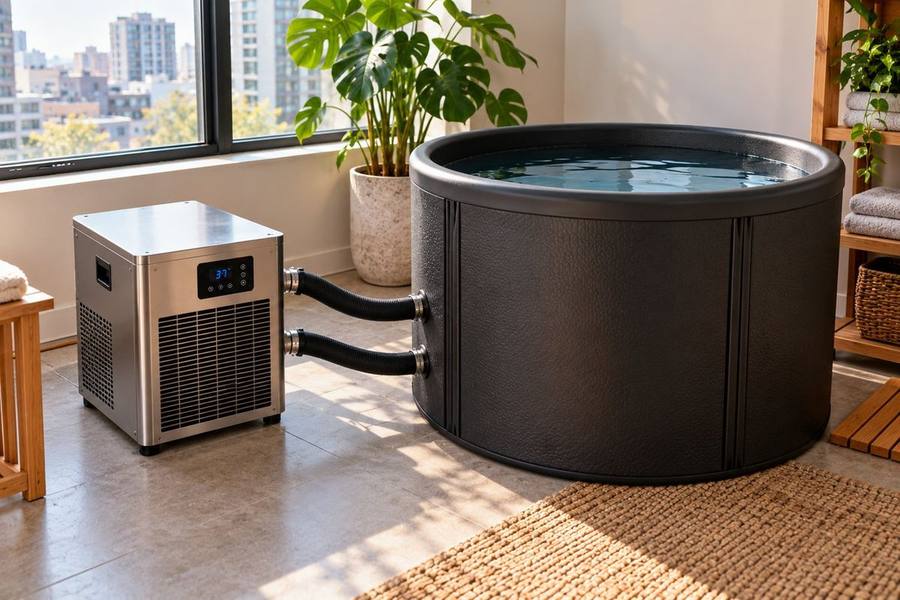
A refrigerated cold plunge does not have to cost $4,000. A cold plunge chiller for apartment use can be compact, quiet, and powered by a standard
120V outlet.
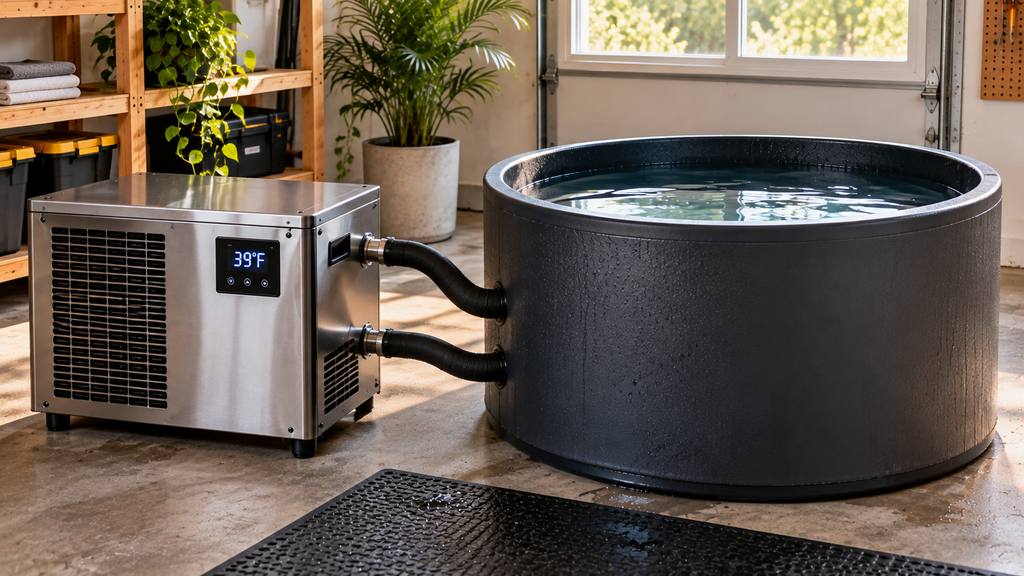
If you already own a portable plunge, stock tank, Ice Barrel-style tub, or even have a suitable bathtub, adding a standalone water chiller can give you
active temperature control for well under $1,500.
For apartment dwellers, though, raw cooling power is not the only thing that matters.
A 1 HP commercial chiller might look impressive on a specification sheet, but it can also be large, noisy, electrically demanding, and unnecessarily
powerful for a 60-gallon portable plunge sitting five feet from your bedroom.
For a small home, the better questions are:
How much cooling capacity do you actually need? How loud is the compressor? Does it use a standard 120V outlet? Is the pump included? And how complicated will the plumbing be?
Those questions lead to a very different shortlist than simply buying the biggest chiller under $1,500.
Bottom Line
The The Pod Company Universal Ice Bath Chiller is the best overall choice for most apartment users.
At a current price of around $599, it combines a 1/3 HP compressor, 280W power draw, standard 110V US plug with GFCI protection, approximately
39–45 dB published noise level, pump, hoses, and 20-micron filtration in a 12″ × 12″ × 13″ package. The current version is rated to cool water to
approximately 39–41°F depending on configuration and conditions.
The Pod Company Universal Ice Bath Chiller
If you want more cooling capacity and are comfortable building the circulation system yourself, the Active Aqua 1/4 HP Chiller with Power Boost is
our DIY pick. Hydrofarm rates it at 3,010 BTU/hr for approximately 40–92 gallons, with a 460W draw on 120V power.
For a larger 90–170-gallon plunge, step up to the Active Aqua 1/2 HP. It produces 4,020 BTU/hr and currently carries a manufacturer suggested retail
price of $1,099.
If compressor noise is your biggest concern, the JBJ Arctica 1/3 HP DBM-250 deserves a look. It costs around $1,165 from current US retailers,
produces roughly 4,000 BTU/hr, uses 115V power, and the Arctica line is specifically designed around low-noise aquarium installations.
One notable omission is Penguin Chillers. Penguin makes legitimate purpose-built cold-therapy equipment, but its current 7,500 BTU Cold Therapy
Chiller is around $1,950, putting it outside the $1,500 limit for this guide.
If your budget is closer to $1,000, see our guide to cold plunge chillers under $1,000.
Quick Comparison
| Chiller | Approx. price | Cooling capacity | Power draw | Published/available noise info | Best for |
| The Pod Company Universal Chiller | $599 | 1/3 HP; down to ~39–41°F | 280W | ~39–45 dB | Best overall apartment setup |
| Active Aqua 1/4 HP | $799 MSRP | 3,010 BTU/hr | 460W | Manufacturer does not publish a useful dB rating | Small/medium DIY plunges |
| Active Aqua 1/2 HP | $1,099 MSRP | 4,020 BTU/hr | 510W | Manufacturer does not publish a useful dB rating | Larger tubs / warmer rooms |
| JBJ Arctica 1/3 HP DBM-250 | Around $1,165 | ~4,000 BTU/hr | 115V, ~7.2A* | Arctica line marketed around low-noise operation; specialist seller cites ~39–42 dB | Quiet DIY installations |
*JBJ documentation and current retailer specifications should be checked for the exact electrical input figure on the unit you receive; current product
listings identify the DBM-250 as a 115V unit with approximately 7.2–7.25A input.
Prices were checked in October 2026 and can change.
What Does a Cold Plunge Chiller Actually Do?
A cold plunge chiller is basically a refrigeration system for water.
Water leaves the plunge, passes through a heat exchanger inside the chiller, and returns colder.
The thermostat monitors temperature and turns the compressor on when additional cooling is required.
That sounds simple, but a working cold plunge system actually needs several components:
- Chiller
- Water pump
- Intake and return hoses
- Appropriate fittings
- Filtration
- Electrical power
- Adequate airflow around the chiller
Some products package most of those parts together.
Others sell you essentially the refrigeration component and expect you to build the rest of the system.
That distinction matters when comparing prices.
A $700 chiller that requires another 150-300 of pump, filter, hoses, fittings, clamps, and adapters is not necessarily cheaper than a $900 package
that includes everything.
A Chiller Does Not Make Water Sanitary
Cooling and filtration are also different jobs.
A chiller removes heat.
A filter removes particles.
Neither automatically disinfects water.
If you intend to leave the same water in a plunge for weeks, follow the tub and chiller manufacturers’ water-care instructions rather than assuming
45°F water cannot grow microorganisms.
Why $1,500 Is a Useful Price Limit for Apartment Buyers
Once you move above roughly $1,500–$2,000, the economics start changing.
Penguin’s current purpose-built Cold Therapy Chiller, for example, is around $1,950. Premium standalone systems from major cold-plunge
companies can cost $3,000-$4,000.
At that point, someone who does not already own a tub should start comparing the total DIY cost against complete plunge systems.
Under $1,500 is different.
You can take a 100–1,000 tub you already own and add active cooling without replacing the entire setup.
That is especially useful in an apartment because portable tubs have several advantages:
- They can be drained before moving.
- Some fold or collapse.
- You avoid a permanently installed 500-pound tub.
- Smaller chillers can run from 110–120V power.
- You can separate the tub and refrigeration equipment when moving.
The downside is that you are building a system from components.
The cheaper the chiller, the more attention you generally need to pay to pumps, hoses, filtration, airflow, and leak prevention.
1. The Pod Company Universal Ice Bath Chiller — Best Overall for Apartments
The Pod Company Universal Ice Bath Chiller
For a renter or condo owner, this is the first option I would consider.
The current Universal Chiller costs approximately $599 and is specifically packaged for connecting to an existing plunge, bathtub, stock tank, or
similar container.
The standard chiller uses a 1/3 HP compressor with approximately 280W power consumption.
It plugs into a normal 110V US outlet, and the supplied power connection includes GFCI protection.
The manufacturer publishes a noise level around 39–45 dB, depending on operating conditions.
That is unusually useful information for apartment buyers.
The chiller itself measures only about:
12″ × 12″ × 13″
and weighs approximately 39 pounds.
What Comes With It?
Unlike most hydroponic or aquarium chillers, the Universal Chiller is sold as a cold-plunge system.
The current package includes:
- Water chiller
- Hose connections
- Hose set
- Submersible pump
- 20-micron filter
- 110V GFCI power cable
The manufacturer currently advertises a two-year warranty.
That makes the $599 price considerably more meaningful than a bare chiller at the same price.
Cooling Performance
The standard version has historically been rated to approximately 41°F, while The Pod Company’s current Universal Chiller page advertises cooling
as low as approximately 39°F under suitable conditions. Ambient temperature, tub insulation, water volume, sunlight, and starting temperature all
affect what you will achieve in practice.
For most users, that distinction is not important.
You do not need 39°F water simply because the equipment can produce it.
If your preferred plunge temperature is 45–55°F, this unit has more practical relevance than chasing the lowest possible number.
Verified buyer reviews frequently mention that the initial cooldown from room-temperature water takes 4–6 hours in a warm apartment, but
maintaining temperature afterward is much faster. A common note is that the included 20-micron filter needs more frequent cleaning than expected.
Pros
- Around $599
- Purpose-built for cold plunges
- Pump included
- 20-micron filtration included
- Hoses included
- 110V
- GFCI-equipped power connection
- Only about 280W
- Approximately 39–45 dB published noise rating
- Compact 12″ × 12″ × 13″ dimensions
- Can connect to tubs from other manufacturers
- Two-year warranty currently advertised
Cons
- 1/3 HP is less powerful than larger DIY chillers
- Initial cooldown can take several hours
- Performance depends heavily on tub insulation and ambient temperature
- Soft hoses and external pump add clutter
- Some current owner reviews report confusing setup instructions or needing extra attention to hose connections and seals.
Who Should Buy It?
This is the best choice if you live in an apartment and want the least complicated path from an ice-cooled tub to active refrigeration.
It is particularly attractive if your plunge is in a bathroom or other indoor space where noise matters.
2. Active Aqua 1/4 HP Chiller — Best DIY Value for Smaller Tubs
Active Aqua is not primarily a cold-plunge company.
Its chillers are designed for hydroponic reservoirs.
That sounds like a disadvantage, but these units have become popular in DIY cold-plunge builds because they provide legitimate refrigeration
capacity, titanium evaporators, and standard plumbing connections at reasonable prices.
The 1/4 HP AACH25HP currently has an MSRP around $799. Hydrofarm rates it for approximately 40–92 gallons.
Cooling output is rated at:
3,010 BTU/hr
Power consumption is approximately:
460W
Electrical service is:
120V
Hydrofarm also includes 1/2-inch and 3/4-inch fittings.
Why the 1/4 HP Model Makes Sense in an Apartment
Bigger is not automatically better.
If you have a 50–70-gallon plunge inside a climate-controlled apartment, you may not need a 1 HP compressor.
The 1/4 HP model is smaller, lighter, and less electrically demanding than Active Aqua’s larger units.
It measures approximately:
18″L × 13″W × 17″H
and weighs around 41 pounds.
The Catch: You Need a Pump
This is not a plug-and-plunge package.
Hydrofarm specifies a required flow range and recommends compatible Active Aqua pumps.
For the 1/4 HP model, the published flow range is approximately 396–925 gallons per hour.
You therefore need to budget for:
- Pump
- Tubing
- Filter
- Hose clamps
- Bulkhead fittings if your tub requires them
- Adapters
- Potential shutoff valves
The DIY system can still cost less than a premium plunge chiller, but it takes more planning.
DIY cold plungers on Reddit frequently pair this chiller with a 50-gallon stock tank and a 500 GPH pump. The most common complaint is the initial
pump-matching work — owners report spending 1–2 hours finding the right flow rate and fittings.
Pros
- $799 MSRP
- 3,010 BTU/hr
- 120V
- 460W
- Pure titanium evaporator
- Good size for roughly 40–92-gallon reservoirs according to Hydrofarm
- 1/2-inch and 3/4-inch fittings included
- Established manufacturer
Cons
- Pump not included
- Filtration not included
- Plumbing required
- Designed for hydroponics rather than specifically for human cold plunges
- Indoor-use-only rating
- Hydrofarm does not publish a useful official noise figure for direct apartment comparison
- Larger than The Pod Company unit
Who Should Buy It?
Choose the 1/4 HP Active Aqua if you enjoy DIY projects and already understand how you want to circulate and filter the water.
If you want something that arrives with almost everything needed, buy The Pod Company instead.
3. Active Aqua 1/2 HP Chiller — Best for Large Apartment Plunges
The 1/2 HP Active Aqua is where the line starts making sense for larger tubs.
Hydrofarm currently lists the AACH50HP at an MSRP of $1,099.
Its published specifications include:
- 4,020 BTU/hr
- 510W
- 120V
- 5.4A
- Recommended volume of approximately 90–172 gallons
- 800–1,600 GPH flow range
- Pure titanium evaporator
- 1/2″, 3/4″, and 1″ fittings
The unit measures approximately 19″L × 14″W × 19″H and weighs about 48.5 pounds.
Why Not Just Buy the 1 HP Version?
Active Aqua actually sells a 1 HP chiller for exactly $1,499 MSRP.
It produces 10,050 BTU/hr but draws approximately 1,100W and weighs 69 pounds.
For most apartments, that is unnecessary.
If your plunge requires a 1 HP commercial-style water chiller to stay cold, you should probably reconsider the tub’s insulation, placement, or overall setup.
The 1/2 HP is a more sensible compromise.
Electrical Warning: A 1/2 HP refrigeration rating is not the same as the unit’s electrical input wattage. If a unit draws high wattage at 120V, it can
exceed a standard 20A circuit before considering other loads. Owners who upgrade to higher-capacity models frequently discover that electrical
requirements become a larger installation expense than expected, so have an electrician verify the nameplate load before purchasing.
Owners using this model for cold plunges typically have tubs in the 100–150-gallon range. The most commonly reported issue is noise — several
reviewers mention the compressor is noticeably louder than smaller aquarium chillers, though acceptable in a garage or utility room.
Pros
- $1,099 MSRP
- 4,020 BTU/hr
- 510W
- Standard 120V operation
- Pure titanium evaporator
- Suitable for larger water volumes
- Multiple fittings included
- Power Boost function for initial cooling
Cons
- Pump not included
- Filtration not included
- Requires high water flow
- Larger footprint
- More compressor and fan noise than the smallest apartment-oriented systems
- Indoor-use-only rating
- Overkill for a small 50-gallon pod
Who Should Buy It?
Choose this model if your tub holds around 90 gallons or more, or if you are dealing with a warmer environment where a smaller chiller would have
to run constantly.
For a 50-gallon portable plunge inside an air-conditioned apartment, I would save the money and space.
4. JBJ Arctica 1/3 HP DBM-250 — Best for Noise-Sensitive Apartments
The JBJ Arctica is another aquarium-derived option rather than a purpose-built cold-plunge appliance.
Its advantage is noise.
The Arctica range has been designed for aquariums that often sit inside living rooms, offices, and other occupied spaces.
Current specialist listings put Arctica operating noise around 39–42 dB for the line, while JBJ and retailers emphasize low vibration and quiet operation.
The DBM-250 1/3 HP model currently costs around $1,165 from major US aquarium retailers.
Cooling capacity is approximately:
4,000 BTU/hr
Current JBJ specifications list:
- 115V
- 1/3 HP
- Titanium heat exchanger
- 480–2,420 GPH recommended flow range
- Approximately 61-pound weight
- Multiple 1/2″, 5/8″, and 3/4″ adapters
Why Consider an Aquarium Chiller?
A compressor cycling on and off six feet from your couch is very different from one running in a detached garage.
The JBJ’s low-noise design is therefore genuinely useful.
It also uses a titanium heat exchanger, which is exactly what you want in a durable water-cooling system.
But you are still building the rest of the cold plunge yourself.
The pump is not an integrated cold-plunge circulation system, and you need to match your pump to the required flow.
Aquarium owners and cold plungers both report the Arctica is noticeably quieter than hydro-style chillers at the same horsepower. The most
common complaint in reviews is the cost of replacement parts, which reflects its premium aquarium positioning rather than cold-plunge marketing.
Pros
- Around $1,165
- Approximately 4,000 BTU/hr
- 115V
- Titanium heat exchanger
- Low-noise design
- Low vibration
- Multiple hose adapters
- Long-established aquarium chiller line
- Current JBJ listing gives a two-year warranty
Cons
- Pump not included
- Filtration not included
- 61 pounds
- Requires high circulation flow
- Designed for aquariums rather than cold plunges
- More DIY work than The Pod Company
- Relatively expensive for the cooling capacity
Who Should Buy It?
The Arctica makes sense if noise is your biggest constraint and you are comfortable designing your own pump and filtration loop.
If your plunge sits beside a home office or near a bedroom, paying extra for quieter compressor operation can be more useful than buying another
2,000 BTU/hr of cooling power.
Electrical and Installation Requirements
One encouraging result from this comparison is that none of our four picks requires 220–240V power.
All operate on standard US household voltage.
That does not mean you should ignore electrical safety.
110V/115V/120V Are Essentially the Same Household Class Here
Manufacturers use slightly different labels:
- 110V
- 115V
- 120V
For these products, they refer to equipment designed around normal North American household electrical service.
You do not need the 240V circuit commonly required for a traditional electric sauna heater.
GFCI Protection Matters
Water and electricity are being used in the same installation.
The Pod Company’s current Universal Chiller package includes a US 110V GFCI-protected power connection.
For DIY aquarium or hydroponic chillers, have the installation comply with the manufacturer’s instructions and applicable electrical requirements for your location.
Do not run improvised extension cords across wet bathroom floors.
Do not place ordinary power strips beside the plunge.
And do not bypass a GFCI device because it trips.
A recurring trip indicates a problem that needs to be identified.
Hose Connections
The easiest installation is The Pod Company system because the package includes a pump and hoses designed for plunge use.
Active Aqua and JBJ require more planning.
You need to maintain the manufacturer’s required flow through the heat exchanger.
Too little flow can reduce cooling performance and potentially create operational problems.
That is why buying a random $20 aquarium pump is not a good plan.
Match:
pump flow → filter restriction → hose diameter → chiller flow requirement
as a complete system.
Plan for Leaks
This matters more in an apartment than in a garage.
A dripping fitting on a concrete patio is annoying.
A dripping fitting above your downstairs neighbor’s ceiling can become expensive.
After assembly, run the circulation system and inspect every connection before leaving it unattended.
A waterproof equipment tray or leak sensor beneath the chiller/pump area is inexpensive insurance where appropriate.
How Loud Is a Cold Plunge Chiller in an Apartment?
This is one specification I would not ignore.
A compressor does not produce a constant gentle hum.
It cycles.
That means your apartment can be silent and then suddenly the compressor and fan start.
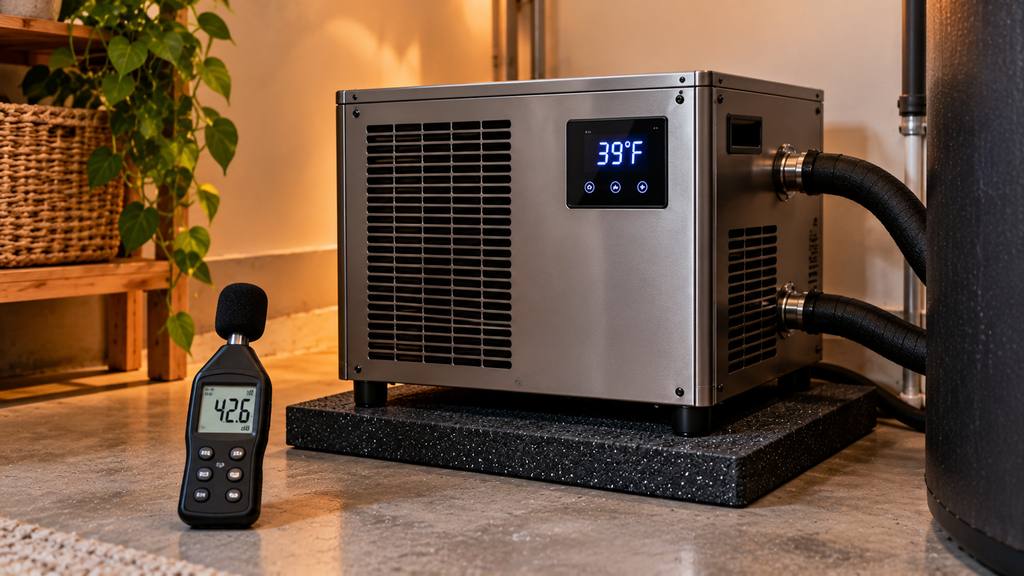
Under 45 dB: The Target for Living Spaces
The Pod Company publishes approximately 39–45 dB for its Standard Chiller.
Specialist Arctica listings put that chiller line around 39–42 dB, consistent with its positioning for aquariums in occupied rooms.
Those are the two I would investigate first for a studio apartment.
Around 55–65 dB: Much More Noticeable
Larger hydroponic chillers can be significantly more audible.
Hydrofarm does not publish an official comparable dB figure for the Active Aqua units on its current specification pages, so I would not invent one.
Independent current measurements and reviews commonly put the 1/2 HP Active Aqua roughly around the upper-50s to low-60s dB while
operating. Treat those numbers as third-party observations rather than manufacturer specifications.
That can be perfectly acceptable in a garage.
It is much harder to ignore next to a bed.
Reduce Vibration
Even a quiet compressor can become irritating when vibration travels through a hard apartment floor.
A manufacturer-approved rubber isolation pad can reduce vibration transfer.
Do not enclose the chiller inside a sealed soundproof box.
Chillers need airflow to reject heat.
Block that airflow and the equipment becomes less efficient while the surrounding enclosure becomes hotter.
FAQ
What size chiller do I need for a cold plunge?
It depends on water volume, insulation, ambient temperature, starting water temperature, sunlight, and target temperature.
A 1/4 HP unit can be adequate for many small insulated tubs.
Larger 90–150-gallon systems may benefit from 1/2 HP or more.
Do not size the chiller from horsepower alone. Compare actual BTU/hr ratings and manufacturer sizing guidance.
Why BTU/h Matters More Than Horsepower: Horsepower describes motor or compressor size; it does not establish delivered cooling capacity.
Request BTU/h (the amount of heat removed per hour) together with the conditions used to measure it. For example, reducing 100 gallons of water
from 75°F to 45°F requires removing approximately 25,020 BTU of heat from the water alone. If a chiller delivers a constant 5,000 BTU/h of effective
cooling, the theoretical minimum cooldown time is about five hours. Actual time will be longer.
Can I use an aquarium chiller for a cold plunge?
People do, and both JBJ and Active Aqua use titanium heat exchangers suitable for water-cooling applications.
But these are not complete cold-plunge sanitation systems.
You still need appropriate circulation, filtration, plumbing, electrical protection, and water maintenance.
Can I connect a chiller to my bathtub?
Some systems can.
The Pod Company’s Universal Chiller is specifically marketed for use with existing tubs and bathtubs and includes drop-in hoses and a pump.
That is more renter-friendly than drilling permanent bulkhead holes through a tub.
Do not make permanent plumbing modifications to a rental without permission.
For a full guide to bathroom cold plunge setups, see our article on setting up a cold plunge in a small bathroom.
For balcony installations with a chiller, see our guide to setting up a cold plunge on a small balcony.
Will a cold plunge chiller trip a normal apartment breaker?
The four chillers here are all 120V-class equipment and do not approach the electrical demand of a 240V sauna heater.
The Pod Company’s 280W unit is particularly light electrically.
But circuit loading still matters.
A chiller sharing a circuit with a microwave, portable air conditioner, space heater, or other high-draw appliance can create problems.
Check the manual and your circuit capacity.
Should I leave my chiller running 24/7?
Follow the manufacturer’s instructions.
Maintaining already-cold water can sometimes be more practical than repeatedly allowing it to warm significantly and then cooling the entire
volume again.
The compressor normally cycles according to the thermostat rather than drawing maximum power continuously.
Filtration and circulation requirements also influence whether continuous operation makes sense.
How long does a cold plunge chiller take to cool water?
There is no useful universal answer.
A small insulated tub starting at 60°F is completely different from a 120-gallon outdoor tub starting at 85°F.
Chiller capacity, water volume, insulation, room temperature, target temperature, and flow all matter.
Plan initial cooling in hours rather than minutes for most small residential systems.
Is a 1 HP chiller better than a 1/3 HP chiller?
Only if you need the additional capacity.
The Active Aqua 1 HP produces 10,050 BTU/hr, but it also draws 1,100W and weighs 69 pounds.
For a small indoor apartment plunge, that is usually unnecessary.
Correct sizing is better than maximum horsepower.
Does the heat exchanger material matter?
Yes. The heat exchanger transfers heat from the plunge water to the refrigeration system. Titanium is valued for its corrosion resistance, while
copper transfers heat efficiently but can corrode if exposed to certain water-treatment chemicals. Ask the manufacturer which material actually
contacts the circulating water, and confirm approved sanitizers and water-quality limits before buying.
Is a chiller cheaper than buying ice?
It can be if you plunge frequently.
If you spend $5–$10 on bagged ice several times per week, the recurring expense can quickly exceed the electricity needed to maintain a
refrigerated plunge.
The financial advantage becomes less obvious if you make ice cheaply at home or only plunge occasionally.
Final Recommendation
For the typical apartment buyer, I would choose the The Pod Company Universal Ice Bath Chiller.
The Pod Company Universal Ice Bath Chiller
It is not the most powerful chiller here.
That is precisely why it works.
At around $599, you get the chiller, pump, hoses, filtration, and GFCI-equipped power connection in a package drawing only about 280W. Its 12″ ×
12″ × 13″ footprint is easier to accommodate than a large hydroponic chiller, and the published 39-45 dB noise range is far more appropriate for
living space.
For a DIY 40–90-gallon plunge, I would choose the Active Aqua 1/4 HP.
Its 3,010 BTU/hr capacity gives you more refrigeration hardware for the money, but you must build the pump and filtration system around it.
For a larger 90-gallon-plus tub, move to the Active Aqua 1/2 HP.
At 4,020 BTU/hr and $1,099 MSRP, it remains under the $1,500 ceiling while offering substantially more capacity than compact plug-and-play units.
And if your plunge is close to a bedroom, desk, or living area, the JBJ Arctica 1/3 HP deserves serious consideration.
You pay more for a system that still requires a separate pump, but low compressor noise and vibration are not luxury features when you share walls
with neighbors.
The main lesson is simple:
Do not buy a cold plunge chiller based on horsepower alone.
For apartment use, I would prioritize the decision in this order:
noise → electrical requirements → leak-safe installation → cooling capacity → filtration → price.
A quiet 1/3 HP chiller that reliably holds your insulated tub at 48°F is a much better apartment purchase than a noisy 1 HP machine capable of
reaching 39°F twice as fast.
And remember that the chiller does not solve the biggest apartment constraint: water weight.
Even a compact plunge can hold hundreds of pounds of water. If you are considering a balcony installation, verify that the location is suitable rather
than assuming a portable tub is automatically safe simply because it is lightweight when empty.
For compact tub options, see our guide to the 3 best small cold plunges for apartments.
For the decision between buying a chiller and continuing to use ice, see our comparison of cold plunge vs ice bath.
And if you are planning a complete hot-and-cold setup, see our guide to setting up a sauna in a garage.
This post contains affiliate links. If you buy through them, we may earn a commission at no extra cost to you.