Disclosure: This article contains affiliate links, including Amazon Associates links. We may earn a commission from qualifying purchases at no extra cost to you.
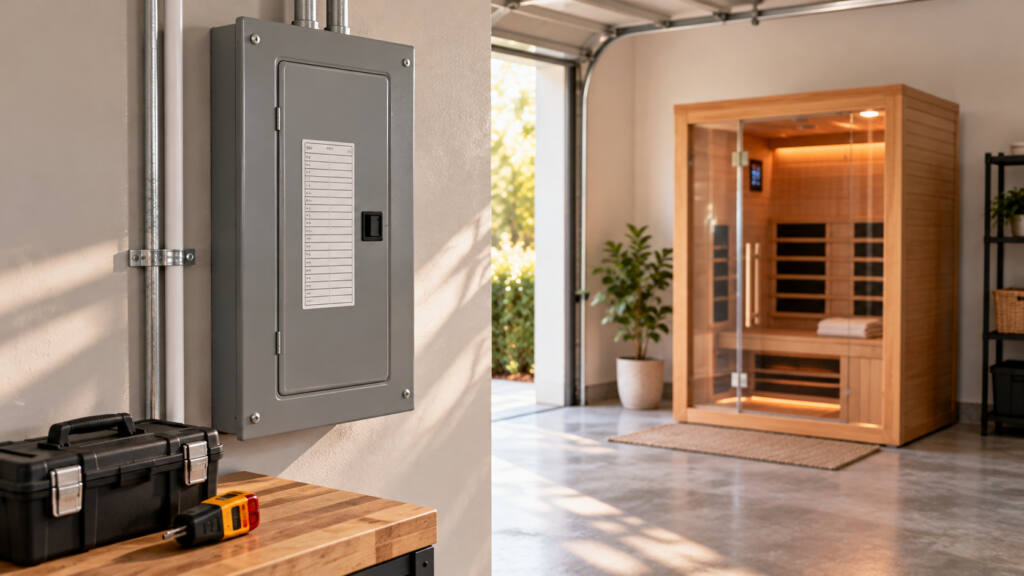
A dedicated circuit for a home sauna is one of the most important electrical requirements to check before buying, even if the sauna plugs into a standard 120V household outlet.
For many first-time buyers, the surprise is that a sauna advertised as plug-and-play may still need its own electrical circuit.
A compact infrared cabin might use an ordinary-looking three-prong plug, but that does not mean it can safely share power with a refrigerator, space heater, washing machine, or other high-demand appliance.
Traditional electric saunas introduce another level of planning. Their larger heaters commonly require 240V power, dedicated wiring, and professional installation.
For apartment renters and small-home owners, these electrical requirements can determine which sauna is practical before dimensions, wood type, or heater features even enter the decision.
This guide explains dedicated circuits, 120V versus 240V power, breaker sizing, GFCI protection, electrical panel capacity, installation costs, and what to do if your home cannot accommodate a new circuit.
Bottom Line: Do You Need a Dedicated Circuit for a Home Sauna?
Most home saunas need a dedicated electrical circuit. A 120V infrared cabin commonly requires its own 15A or 20A circuit, depending on its actual electrical rating and manufacturer instructions. A traditional electric sauna with a 240V heater normally requires a dedicated 240V branch circuit, often 30A or larger, although the correct size depends on heater wattage and installation requirements. An ice-only cold plunge needs no electrical supply, while a chiller-equipped cold plunge may benefit from a dedicated 120V circuit and may require one under its instructions or the applicable electrical design. Before purchasing, obtain the exact model’s electrical specifications and have a qualified electrician confirm that your home can support them.
What Is a Dedicated Circuit?
A dedicated circuit is an electrical branch circuit intended to supply a particular appliance or piece of equipment rather than several unrelated loads.
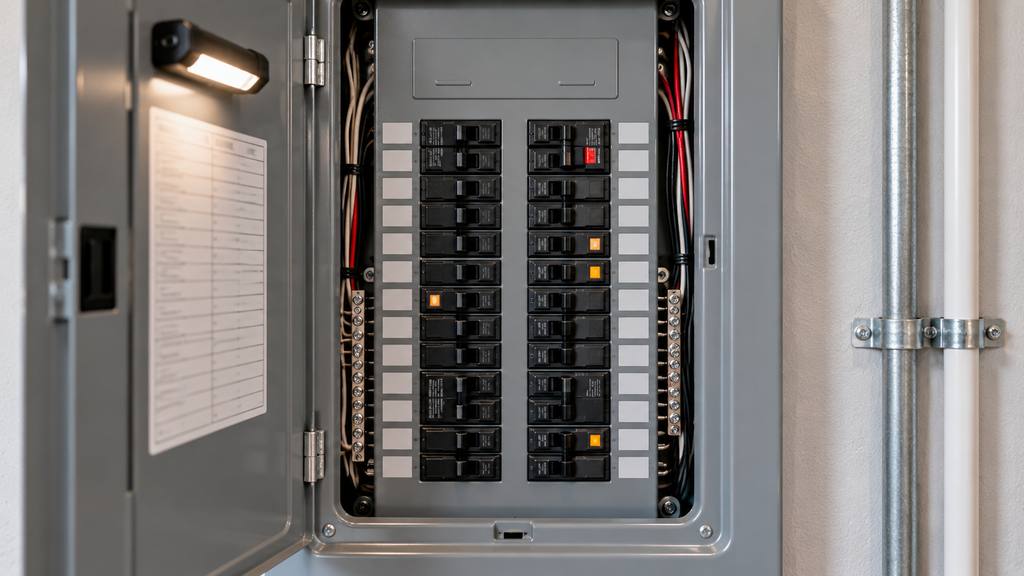
In a typical US home, electricity travels from the main electrical panel through a circuit breaker and wiring to outlets, lighting, or permanently connected equipment.
A dedicated sauna circuit supplies the sauna according to its approved electrical design.
That does not always mean there is literally one receptacle on the circuit in every possible installation, but when a sauna manufacturer specifies a dedicated circuit, you should follow its requirements rather than assume other appliances can share it.
Why Shared Circuits Can Trip
Imagine a 120V, 15A branch circuit supplying several garage outlets.
You connect a 1,500W infrared sauna to one outlet.
At 120V, its nominal current is:
1,500W ÷ 120V = 12.5A
Now suppose another appliance on the same circuit draws 500W.
The combined load becomes:
2,000W ÷ 120V = approximately 16.7A
That exceeds the circuit’s 15A rating.
The breaker may trip, interrupting power to the sauna and the other equipment.
More importantly, operating equipment contrary to its electrical requirements can create overheating and fire hazards.
Why a Dedicated Circuit Helps
A properly designed dedicated circuit reduces competition for electrical capacity.
It also makes it easier to identify the correct breaker, isolate the sauna for servicing, and follow the manufacturer’s installation instructions.
However, a dedicated circuit does not automatically mean the wiring is correctly sized or that the electrical panel has enough overall capacity.
Those are separate questions.
When You Need a Dedicated Circuit for a Sauna
The answer depends on the sauna’s heater type, electrical rating, and installation instructions.
120V Infrared Saunas: Usually Yes
Many compact infrared saunas are designed for standard US 120V power.
Their heating systems often draw approximately 1,200–1,800W, although models vary.
A manufacturer may specify a dedicated 15A or 20A circuit.
For example, a sauna drawing 1,500W has a nominal current of 12.5A at 120V.
Whether that load can be supplied by a particular 15A circuit depends on applicable electrical rules, load classification, equipment listing, and the manufacturer’s instructions.
Do not simply assume that because 12.5A is below 15A, the installation is automatically compliant.
240V Traditional Saunas: Yes
Traditional electric saunas use a heater that warms stones and the surrounding air.
Residential electric sauna heaters commonly range from approximately 4.5kW to 9kW or more.
These heaters typically require a dedicated 240V circuit.
For example, a 6,000W heater operating at 240V draws a nominal:
6,000W ÷ 240V = 25A
That does not mean a 25A breaker is necessarily appropriate.
The final circuit design must account for the heater’s instructions, applicable code requirements, conductor ratings, and any required sizing factors.
A 30A or larger circuit may be specified, depending on the equipment.
Owners who upgrade from a compact infrared cabin to a traditional electric sauna frequently encounter higher installation costs because the existing outlet cannot supply the new heater, so confirm the electrical requirements before committing to the larger model.
Plug-In Infrared Cabins: A Plug Does Not Eliminate the Requirement
A sauna with a factory-installed 120V plug may be marketed as easy to install.
That description generally refers to avoiding hardwiring.
It does not guarantee that any available household outlet is suitable.
Many plug-in infrared cabins still specify a dedicated circuit.
The Dynamic Barcelona, sold under Golden Designs, is an example of a compact 120V infrared sauna worth investigating.
Before purchasing, confirm the exact model’s voltage, wattage, plug configuration, circuit requirements, and current installation manual.
Direct-Wire Saunas: Follow the Equipment Rating
A direct-wire sauna connects to permanent electrical wiring rather than a conventional plug.
Traditional electric sauna heaters are commonly hardwired at 240V in US residential installations.
However, not every hardwired sauna component is necessarily 240V.
Controls, lighting, and specialized systems may have different electrical requirements.
The correct approach is to follow the complete equipment wiring diagram and manufacturer instructions.
For a typical 240V traditional electric heater, expect a dedicated circuit and professional installation.
120V vs. 240V: What’s the Difference?
The voltage determines how much current is needed to deliver a particular amount of electrical power.
The basic relationship is:
Watts = Volts × Amps
Understanding Typical Sauna Loads
| Sauna heater load | Supply voltage | Nominal current |
| 1,200W infrared | 120V | 10A |
| 1,500W infrared | 120V | 12.5A |
| 1,800W infrared | 120V | 15A |
| 4,500W traditional | 240V | 18.75A |
| 6,000W traditional | 240V | 25A |
| 8,000W traditional | 240V | 33.3A |
These are arithmetic examples, not breaker-sizing recommendations.
Actual equipment ratings, circuit design, and installation requirements must be verified separately.
Does 240V Mean More Power?
Not automatically.
A 1,500W heater uses approximately the same electrical energy whether designed to operate at 120V or 240V.
At 240V, it draws half the current of an equivalent 120V load.
That can reduce current-related voltage drop and conductor losses for a comparable circuit design, but it does not make the heater inherently more energy-efficient or change the basic energy needed to produce the same amount of heat.
Traditional 240V saunas are often more powerful because they use higher-wattage heaters, not simply because the voltage is higher.
Breaker Size and Wire Gauge
Common US residential branch circuits include 15A and 20A circuits at 120V, along with larger 240V circuits.
Typical copper conductor arrangements may include 14 AWG for some 15A circuits and 12 AWG for some 20A circuits.
But conductor sizing depends on the wiring method, insulation rating, temperature limitations, equipment instructions, and applicable code.
Larger 240V sauna heaters may require substantially larger conductors.
Never select wire gauge or breaker size using a generic chart alone.
An electrician should design the circuit for the exact sauna.
Continuous Loads and Sizing
Electrical rules can require additional circuit capacity for loads classified as continuous.
Some sauna installations may be subject to specific equipment rules or manufacturer instructions affecting sizing.
Do not assume that every sauna automatically follows the same continuous-load calculation.
The electrician should determine the correct classification and sizing method under the locally adopted code.
What About Monthly Electricity Costs?
Electrical voltage alone does not determine your bill.
Energy use depends primarily on power and operating time.
For example, a 1.5kW infrared sauna operating at full power for one hour consumes:
1.5 kWh
At an illustrative electricity rate of $0.18/kWh, that costs approximately $0.27.
A 6kW traditional heater operating at full power for one hour consumes:
6 kWh
At the same rate, that costs approximately $1.08.
Actual consumption varies because heaters cycle, warm-up periods differ, and insulation affects heat loss.
For a more detailed breakdown, see our guide to how much it costs to run a sauna in the US.
GFCI Requirements for Home Saunas
GFCI stands for ground-fault circuit interrupter.
A GFCI is designed to detect certain imbalances between outgoing and returning electrical current and disconnect power quickly when a ground fault is detected.
This protection is especially important around water and damp environments.
Does Every Sauna Need GFCI Protection?
Not necessarily in the same form.
GFCI requirements depend on the sauna’s location, voltage, circuit characteristics, equipment listing, and the electrical code adopted by your jurisdiction.
For example, garage and outdoor receptacles are commonly subject to GFCI requirements under modern editions of the National Electrical Code (NEC).
Bathroom receptacles also have GFCI requirements.
A hardwired sauna heater may be subject to different rules than a plug-in infrared cabin.
The manufacturer’s installation instructions must be followed, but they do not override applicable electrical code. Both must be satisfied.
Why Sauna Location Matters
Consider three installations:
Bedroom infrared sauna: The circuit requirements depend on the equipment and the applicable electrical rules for the room.
Garage infrared sauna: Garage receptacle GFCI requirements may apply, in addition to the sauna’s electrical specifications.
Outdoor traditional sauna: Outdoor installation introduces additional requirements for equipment suitability, wiring methods, moisture protection, and potentially GFCI protection.
Never assume that a circuit acceptable in one location is automatically acceptable in another.
What Causes Nuisance GFCI Trips?
Some sauna owners experience repeated GFCI trips.
Possible causes include moisture entering electrical components, insulation leakage, damaged wiring, heating-element deterioration, or compatibility problems with the equipment.
A GFCI trip may indicate a genuine electrical fault rather than a nuisance.
If a GFCI repeatedly trips, stop using the sauna and have the circuit and equipment inspected.
Do not bypass the protection, replace the GFCI with an ordinary outlet, or repeatedly reset it without identifying the cause.
Useful Electrical Accessories
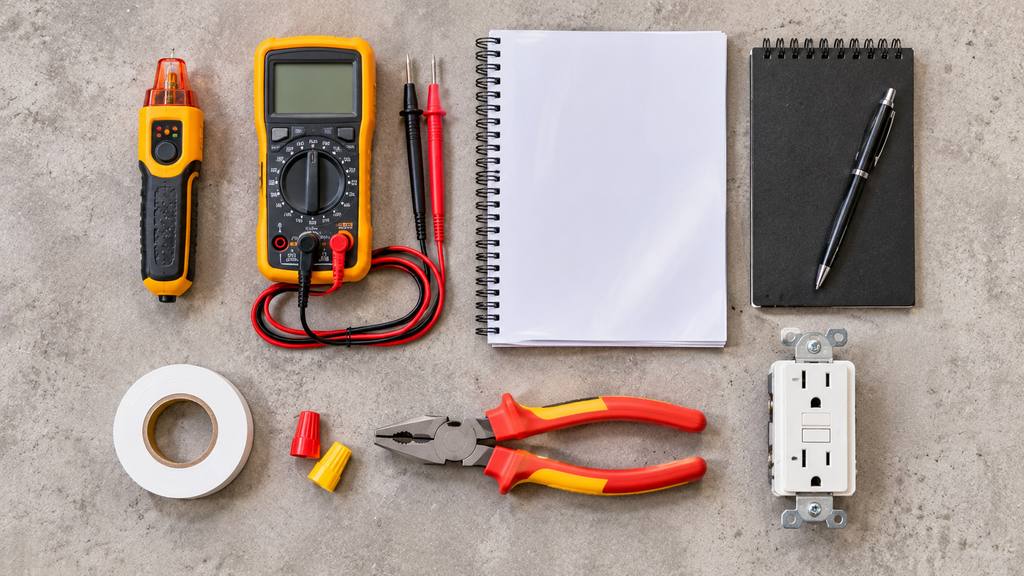
A basic three-light receptacle tester can help identify certain common wiring faults in a conventional 120V receptacle.
One example is Klein Tools RT210 Outlet Tester
Klein Tools RT210 Outlet Tester
It cannot verify circuit capacity, confirm every wiring fault, or establish that an outlet is safe for a sauna.
For a replacement GFCI receptacle, a real product example is the Leviton GFNT2 20A GFCI Receptacle.
Leviton GFNT2-W Self-Test GFCI Receptacle
A 20A GFCI receptacle is not a way to increase a 15A circuit’s capacity. Any replacement must be compatible with the existing circuit and applicable code.
Have a qualified electrician select and install electrical devices where appropriate.
How to Check Your Electrical Panel Capacity
Before buying a sauna, find out whether your electrical system can support it.
You can gather useful information without opening the panel cover or touching internal wiring.
Step 1: Locate the Electrical Panel
The main panel may be in a garage, basement, utility room, or exterior service enclosure.
Some homes also have subpanels.
Look for the panel’s manufacturer label and the main breaker rating, if readily visible.
Common residential services include 100A, 150A, and 200A, although other configurations exist.
Do not assume a 200A service has plenty of spare capacity or that a 100A service cannot support a small sauna.
Actual available capacity requires a load calculation.
Step 2: Look for Available Breaker Spaces
With the panel door open, you may be able to see the breaker handles and circuit labels.
A 120V circuit typically uses a single-pole breaker.
A 240V sauna heater typically requires a two-pole breaker occupying two compatible spaces.
Do not remove the panel’s protective cover to inspect internal wiring.
Step 3: Understand What a Full Panel Means
A panel may have no unused breaker positions.
However, physical space and electrical capacity are different things.
Some listed panel configurations permit specific tandem or other compact breaker arrangements. Others do not.
A subpanel may be an option in certain installations.
Neither approach creates additional service capacity by itself.
Owners who discover that every breaker position is occupied frequently assume they need a complete panel replacement, so ask an electrician to evaluate approved expansion options and actual load capacity before budgeting for an upgrade.
Step 4: Check the Existing Circuit Labels
Identify circuits supplying the proposed sauna location.
A garage receptacle might share a circuit with other outlets or appliances.
A bedroom outlet might share power with lighting and receptacles elsewhere in the home.
Circuit labels can be incomplete or inaccurate, so they are only a starting point.
Do not rely on a label alone to confirm that an outlet has a dedicated circuit.
Step 5: Request a Load Calculation
An electrician can evaluate the home’s existing electrical demand and the proposed sauna load.
This is more reliable than adding up breaker ratings.
The calculation may account for heating, air conditioning, cooking equipment, laundry appliances, water heating, EV charging, and other loads.
When Is a Panel Upgrade Necessary?
A panel or service upgrade may be needed if the existing equipment cannot accommodate the new circuit safely or the electrical service lacks sufficient capacity.
Other reasons may include damaged equipment, obsolete components, or an installation that cannot be expanded in a code-compliant way.
However, a full panel upgrade is not automatically required just because you want a sauna.
A qualified electrician can determine whether a new branch circuit, subpanel, approved load-management solution, or larger service is appropriate.
What an Electrician Will Actually Do
A licensed electrician typically follows a five-stage process when adding a sauna circuit.
1. Evaluate the Electrical Load
The electrician reviews the sauna’s installation manual and electrical nameplate.
They confirm the required voltage, rated current, connection method, circuit protection, and any additional electrical equipment.
They also assess the home’s existing loads.
2. Design the Circuit
The electrician determines the appropriate breaker, conductors, wiring method, and termination arrangement.
For a 120V plug-in sauna, the work may involve installing a correctly rated receptacle at the required location.
For a traditional sauna, the design may include a 240V hardwired connection, disconnecting means where required, and heater controls.
3. Run the Wiring
The electrician routes conductors from the panel to the sauna location.
This may involve accessing an attic, basement, crawl space, or finished wall.
A nearby electrical panel can make the job simpler, but distance is not the only cost factor.
Finished walls, difficult routing, and required surface protection can add labor.
4. Install the Breaker and Connections
The electrician installs compatible circuit protection and makes the electrical connections.
They verify grounding, conductor terminations, and any required GFCI protection.
A breaker must be listed or otherwise approved for the specific panel; matching its physical shape is not sufficient.
5. Test and Arrange Inspection
The electrician tests the completed installation.
Where required, the work is inspected by the local authority having jurisdiction.
Keep the permit and inspection records with your sauna documentation.
This can be useful for future repairs, home sales, and insurance questions.
Real Costs for US Buyers in 2026
Electrical installation costs vary considerably by region, labor rates, panel condition, and wiring distance.
The following are planning estimates for typical residential projects, not guaranteed quotes.
| Electrical work | Estimated US cost | Main cost factors |
| New dedicated 120V circuit | $300–$800 | Distance, access, receptacle location |
| New 240V hardwired sauna circuit | $500–$1,500 | Heater load, wiring distance, installation complexity |
| Electrical panel or service upgrade | $1,500–$3,000+ | Panel type, utility coordination, service equipment |
| Permit and inspection fees | $50–$300+ | Local jurisdiction and project scope |
| Electrical evaluation or troubleshooting | Varies by contractor | Diagnostic time and complexity |
A complicated installation can exceed these ranges.
For example, running a 240V circuit through finished rooms to a detached backyard sauna may cost substantially more than installing a receptacle near an accessible panel.
Example: Small 120V Infrared Sauna
Suppose you purchase a compact 120V infrared cabin and need a new dedicated circuit in an attached garage.
An illustrative budget might include:
- Dedicated circuit installation: $450
- Permit and inspection: $100
- Estimated electrical work: $550
The sauna itself is an additional expense.
Example: Traditional 240V Sauna
Suppose you install a traditional sauna with a 6kW electric heater.
An illustrative budget might include:
- Dedicated 240V circuit: $1,000
- Permit and inspection: $150
- Estimated electrical work: $1,150
Actual circuit sizing must follow the equipment requirements and applicable code.
Example: Panel Upgrade Required
If the existing electrical system cannot support the new installation, a service upgrade may significantly increase the total project cost.
A $2,500 upgrade combined with a $1,000 branch circuit would create a $3,500 electrical budget before buying the sauna.
That is why an electrician’s assessment should happen before you place a nonrefundable order.
For garage-specific planning, see our guide to setting up a sauna in a garage.
Renter-Specific Considerations
Renters face different constraints from homeowners.
Even when a sauna is technically portable, its electrical requirements still apply.
Get Landlord Permission
Do not install new wiring, change outlets, or modify the electrical panel without the required written permission.
A landlord may also restrict large electrical appliances, heaters, or sauna equipment under the lease or building rules.
Ask before buying.
Focus on 120V Plug-In Options
For most renters, a compact 120V infrared sauna is more realistic than a traditional 240V heater.
But a plug-in model may still require a dedicated circuit.
If the apartment has no suitable circuit, the sauna may not be practical without electrical work.
Our guide to the 5 best infrared saunas for apartments that run on standard 120V power covers models designed for smaller spaces.
Do Not Use Adapters to Work Around Electrical Requirements
Avoid extension cords, power strips, multi-outlet adapters, and improvised voltage converters.
A sauna should be connected exactly as the manufacturer specifies.
Consider Alternatives Without Permanent Modifications
A portable infrared sauna blanket may be easier to store than a cabin.
However, it still draws electrical power and must be used on a suitable circuit according to its instructions.
An ice-only cold plunge requires no powered cooling equipment, although it introduces water-weight, drainage, and sanitation concerns.
Neither alternative should be treated as automatically safe for every rental.
What to Do If You Cannot Add a Dedicated Circuit
If an electrician or landlord rules out a new circuit, you still have options.
1. Look for a Lower-Power 120V Sauna
Some lower-power portable sauna products may be permitted on an existing circuit, depending on their listing, instructions, and the other loads supplied by that circuit.
However, conventional infrared cabins frequently specify dedicated circuits.
Do not assume that a low wattage alone permits sharing.
Owners who choose a lower-power sauna to avoid electrical upgrades frequently discover that heat-up time and interior space differ from larger cabins, so compare the actual heating performance and installation instructions before purchasing.
2. Consider an Infrared Sauna Blanket
An infrared sauna blanket can be easier to accommodate in a small apartment.
It does not need the permanent floor space of a wooden cabin.
However, the blanket’s electrical rating still matters.
Check the product’s voltage, wattage, cord requirements, and safety instructions.
Do not use a blanket on an overloaded circuit or with an extension cord prohibited by the manufacturer.
3. Consider an Ice-Only Cold Plunge
An ice-only plunge requires no electrical power for refrigeration.
That can make it an alternative for people interested in a home recovery routine without installing new electrical equipment.
However, cold plunging is not a substitute for sauna heating; the experiences and physiological effects differ.
A filled tub may also impose hundreds of pounds of weight and requires safe drainage.
If you have a suitable garage location, our guide to setting up a cold plunge in a garage explains the practical requirements.
If you later consider refrigerated cooling, see cold plunge chillers under $1,000.
4. Wait Until You Move
If you rent and cannot make electrical changes, waiting may be the most sensible decision.
Buying a sauna that cannot be installed safely is more expensive than postponing the purchase.
You can use the time to research models, establish a budget, and plan for a suitable circuit in your next home.
Frequently Asked Questions
Do I need a permit for a new sauna circuit?
Often, yes.
Many US jurisdictions require permits for new branch circuits and permanent electrical installations.
Requirements vary by location and scope of work.
Ask your local building department or licensed electrician before starting.
Can I plug a sauna into an existing outlet?
Only if the outlet, circuit, and complete installation satisfy the sauna manufacturer’s requirements and applicable electrical code.
A standard-looking 120V plug does not guarantee that the circuit is suitable.
If the manufacturer requires a dedicated circuit, an ordinary shared outlet is not an acceptable substitute.
What size breaker do I need for a sauna?
It depends on the exact sauna’s voltage, electrical load, equipment listing, and installation instructions.
A small infrared cabin may specify a 15A or 20A circuit.
A traditional 240V sauna may require 30A or more.
Do not choose the breaker based on wattage alone.
Can I install a dedicated sauna circuit myself?
Some jurisdictions allow homeowners to perform certain electrical work on their own homes with the required permits and inspections.
However, this is not appropriate for most renters, and mistakes can create serious shock and fire hazards.
Professional installation is the safer choice, particularly for 240V heaters and work inside electrical panels.
Will a 15A circuit run a sauna?
Some 120V infrared saunas are designed for 15A circuits.
Others require 20A circuits.
For example, a 1,500W heater draws approximately 12.5A at 120V, but the final circuit requirements depend on the equipment and applicable electrical rules.
Check the exact model’s manual.
Does a sauna need GFCI protection?
It depends on the installation location, electrical characteristics, locally adopted code, and manufacturer instructions.
Garages, bathrooms, and outdoor locations often have additional GFCI requirements.
Have an electrician confirm the correct protection.
How much does it cost to add a dedicated sauna circuit?
A typical new 120V branch circuit may cost approximately $300–$800.
A 240V hardwired sauna circuit may cost around $500–$1,500.
Long wiring runs, difficult access, permits, and panel upgrades can increase the total.
Can I use an extension cord with a sauna?
Do not use an extension cord unless the manufacturer explicitly permits one and the installation complies with applicable electrical requirements.
Most sauna manufacturers require a direct connection to a suitable receptacle or permanent wiring.
Extension cords can introduce overheating, voltage drop, and connection hazards.
Final Recommendations
If You Are Ready to Buy Now
Before ordering, obtain the exact sauna’s installation manual and electrical specifications.
Confirm the voltage, wattage, current rating, plug or hardwire connection, and required circuit protection.
Then have a licensed electrician evaluate the proposed installation.
If the circuit is suitable and the manufacturer requirements can be met, proceed with the purchase.
Do not rely on product descriptions that simply say standard outlet or plug-and-play.
If You Are Planning Three to Six Months Ahead
Start with the electrical assessment.
Ask an electrician whether the existing panel has sufficient capacity and what the complete circuit installation will cost.
Use that information to compare a 120V infrared cabin with a 240V traditional sauna.
Budget for the sauna, circuit, permits, ventilation, and any required room preparation.
If You Rent and Cannot Modify the Electrical System
Focus on products that can be used safely with the existing electrical installation and are permitted under your lease.
A compact 120V infrared cabin may work if a suitable circuit already exists.
Otherwise, consider a lower-power portable product with compatible electrical requirements or postpone the purchase.
Do not bypass circuit requirements to make a sauna fit your apartment.
The Final Verdict
Most home sauna buyers should plan for a dedicated circuit, even when choosing a 120V plug-in infrared cabin.
For traditional electric saunas, a dedicated 240V installation is normally part of the project.
The most useful step is to verify electrical requirements before buying rather than after delivery.
A short electrician consultation can prevent an expensive mismatch between the sauna you want and the electrical system your home can safely support.
This post contains affiliate links, including Amazon Associates links. If you buy through them, we may earn a commission at no extra cost to you.