Disclosure: This article contains affiliate links, including Amazon Associates links. If you purchase through them, we may earn a commission at no extra cost to you.
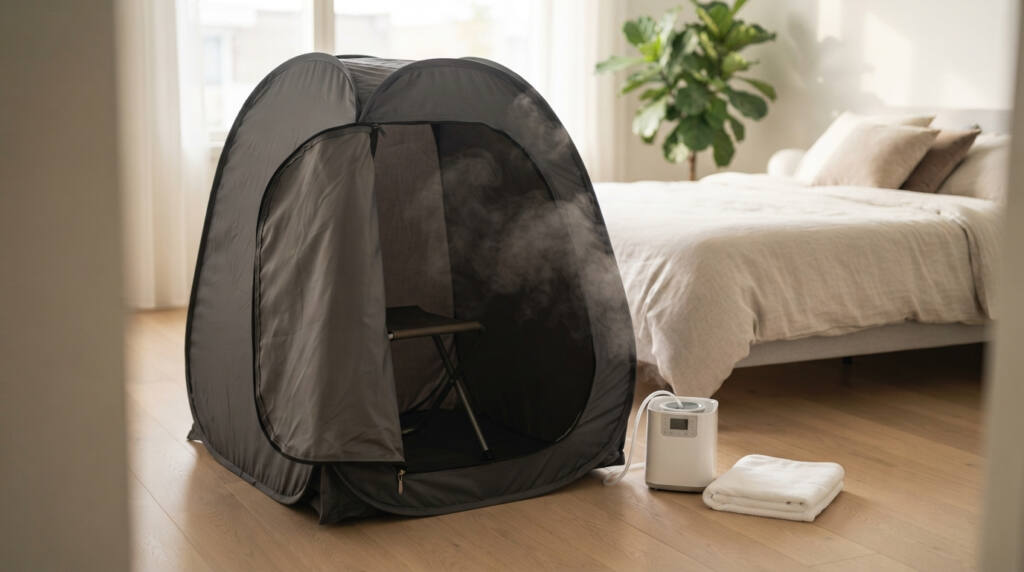
Finding the best pop up sauna for a small apartment means choosing a portable heat system that fits your floor space, works with your home’s electrical supply, and can be packed away without leaving moisture behind.
A traditional wooden sauna cabin can be difficult to justify in a rental apartment. Even compact models occupy permanent floor space, and many traditional heaters require a 240V electrical circuit.
Pop-up saunas offer a different approach.
Most use a collapsible fabric enclosure, a portable steam generator or infrared heating panels, and a standard household electrical connection. When the session ends, the enclosure can be folded and stored.
That makes them attractive to renters, people living in studios, and homeowners who want occasional sauna sessions without dedicating an entire room to the equipment.
However, there are important trade-offs.
A steam sauna creates substantial humidity and requires drying after every session. An infrared model provides a drier heating experience but may feel different from a traditional high-temperature sauna.
Electrical load, seating comfort, and actual setup dimensions also matter.
This guide compares five portable models priced at approximately 100–300, explains their advantages and limitations, and helps you choose a sauna that works in a small US home.
Bottom Line: Which Pop-Up Sauna Should You Buy?
The Homedics Portable Sauna is our best overall recommendation for solo users who want a lightweight, quick-to-assemble portable sauna. Its approximately 35.4-inch footprint, collapsible construction, and advertised one-minute setup make it a practical choice for occasional apartment use.
The other four models serve different needs:
- Manastin Two-Person Steam Sauna: Best for two people who want to share a steam enclosure and have sufficient floor space.
- ZONEMEL Pop-Up Steam Sauna: Best budget and lightweight option, with an advertised empty weight of 9.23 pounds.
- Durasage Personal Foldable Steam Sauna: Best for compact seated sessions where a smaller enclosure is the priority.
- TopMaster Foldable Infrared Sauna: Best for buyers who prefer dry infrared heat instead of a humid steam environment.
For renters, the choice between steam and infrared is just as important as the price.
Steam can provide a warm, humid experience at relatively modest air temperatures, but it introduces moisture that must be managed. Infrared panels provide a drier experience and generally require less post-session moisture cleanup.
Quick Comparison: The 5 Best Pop-Up Saunas in 2026
Prices are approximate planning ranges, not guaranteed current offers. Confirm the exact product variant, electrical nameplate, and current package contents before ordering.
| Product | Approximate price | Heat type | Advertised footprint | Best for |
| Homedics Portable Sauna | $150–$250 | Verify exact model’s heat system | Approximately 35.4″ | Quick solo setup |
| Manastin Two-Person Steam Sauna | $200–$300 | Steam, two generators | 48.5″ × 37″ | Two-person sessions |
| ZONEMEL Pop-Up Steam Sauna | $100–$150 | Steam, 900W | Verify exact base dimensions | Lightweight portability |
| Durasage Personal Foldable Steam Sauna | $100–$180 | Steam, 800W | Approximately 31.5″ | Compact seated use |
| TopMaster Foldable Infrared Sauna | $200–$300 | Infrared, 1,050W | 27.6″ × 31.5″ | Dry infrared heat |
A product’s footprint does not include the space needed for access, ventilation, steam-generator placement, cords, or drying.
1. Homedics Portable Sauna — Best Overall for Solo Use
The Homedics Portable Sauna is our top pick for buyers who want a portable sauna that can be assembled and stored with minimal effort.
It is advertised as a collapsible model weighing approximately 13.7 pounds.
The listed footprint is approximately 35.4 inches, and the maximum advertised temperature is around 115°F.
The product information also claims a setup time of approximately one minute.
Key Specifications
| Feature | Details |
| Approximate price | $150–$250 |
| Empty weight | 13.7 lb |
| Footprint | Approximately 35.4″ |
| Maximum advertised temperature | 115°F |
| Setup time | Approximately 1 minute |
| Heat type | Confirm exact listing and manual |
| Electrical supply | Confirm nameplate voltage and wattage |
Setup and Everyday Use
The main advantage of the Homedics is its collapsible design.
The general setup involves unfolding the enclosure, positioning it on a suitable level surface, arranging the heating components according to the manual, and checking that the entrance and ventilation openings are unobstructed.
The advertised one-minute setup time is useful as a comparison point, but it may refer only to opening the enclosure rather than preparing the complete system for use.
Owners who use portable saunas several times a week often find that putting the enclosure away takes longer than opening it, so include cooldown, cleaning, and drying time when deciding whether the setup fits your routine.
How Hot Does It Get?
The advertised maximum is approximately 115°F.
That is much lower than the air temperature of many traditional Finnish-style saunas, which commonly operate at substantially higher temperatures.
However, the perceived intensity depends on the heating method.
Humid steam and dry infrared heating can feel different even when the advertised temperature is similar.
Because the exact heating configuration for this listing has not been established here, confirm whether the selected model uses steam, infrared panels, or another heat source before purchasing.
Pros
- Advertised one-minute enclosure setup.
- Approximately 13.7-pound weight supports portability.
- Collapsible construction reduces permanent floor-space needs.
- Approximately 35.4-inch footprint suits some small rooms.
Cons
- Maximum advertised temperature is only around 115°F.
- Exact heat type and electrical specifications need confirmation.
- Complete setup and drying may take longer than the advertised assembly time.
- Not equivalent to a traditional high-temperature sauna cabin.
Who It’s Best For
The Homedics is best for solo users who want a portable enclosure rather than a permanent sauna.
It is particularly attractive for renters who need to put the equipment away after use, provided the exact model’s heating method and electrical requirements suit their home.
Owners who use this for quick morning sessions frequently mention that the one-minute setup claim is accurate for the tent itself, but they also note that filling the steam generator and waiting for it to boil adds another 10 minutes to the routine.
Our assessment: The Homedics offers a useful combination of portability and quick assembly, but buyers should confirm its heating system and realistic operating temperature before ordering.
2. Manastin Two-Person Steam Sauna — Best for Couples
The Manastin Two-Person Steam Sauna is designed for buyers who want a shared portable steam enclosure.
Unlike the smaller solo models, it includes two chairs and two steam generators.
The advertised footprint is approximately 48.5 inches by 37 inches, and the enclosure stands approximately 71 inches tall.
The total listed weight is approximately 26.9 pounds.
Key Specifications
| Feature | Details |
| Approximate price | $200–$300 |
| Heat type | Steam |
| Steam generators | Two |
| Chairs | Two included |
| Footprint | 48.5″ × 37″ |
| Height | 71″ |
| Empty weight | Approximately 26.9 lb |
Is It Really Suitable for Two People?
The Manastin offers more interior room than a typical solo steam tent.
However, two-person capacity does not guarantee spacious seating.
Before buying, compare the internal usable width with the dimensions of the included chairs.
You should also confirm the maximum supported user weight for each chair and the enclosure’s ventilation requirements.
At approximately 48.5 inches long, the tent occupies more floor space than most compact solo models.
Warm-Up Time
Some product descriptions for portable steam enclosures advertise warm-up times of around 10 minutes.
For the Manastin, treat a 10-minute warm-up as a claim to verify against the exact current listing and manual, rather than a guaranteed result.
Actual warm-up time depends on room temperature, generator output, water volume, enclosure insulation, and the desired steam conditions.
Owners who share a portable steam sauna often discover that generator filling and post-session drying take more planning than the warm-up itself, so allow time for both people to use and maintain the enclosure comfortably.
Two Steam Generators Mean More Electrical Planning
This is one of the most important considerations.
Two steam generators can create a higher combined electrical load than a single-generator model.
Do not assume both can safely run from the same household circuit.
Check each generator’s rated wattage and the manufacturer’s connection instructions.
If the combined load exceeds the circuit’s safe capacity, the installation is not suitable without appropriate electrical arrangements.
Do not use a power strip or extension cord to connect multiple high-load heating appliances.
Pros
- Two-person enclosure allows shared sessions.
- Includes two chairs and two steam generators.
- Approximately 71-inch height provides more vertical space.
- Portable construction avoids permanent cabin installation.
Cons
- Larger footprint may be impractical in small apartments.
- Two generators require careful electrical-load planning.
- Steam creates humidity and requires thorough drying.
- Warm-up performance and chair capacity need verification.
Who It’s Best For
The Manastin is best for couples or households with enough space for a larger temporary enclosure.
It makes more sense in a suitable ground-level room or utility area than a very small studio bathroom.
Buyers who purchase this for couples often point out that the 10-minute warm-up time is realistic, but you absolutely must plug the two generators into different circuits, otherwise you will trip the breaker the moment you turn them both on.
Our assessment: The Manastin provides a practical shared steam option, but electrical capacity and drying space should be confirmed before treating it as a simple plug-and-play purchase.
3. ZONEMEL Pop-Up Steam Sauna — Best Lightweight Budget Option
The ZONEMEL Pop-Up Steam Sauna is worth considering if portability and low upfront cost matter more than extra interior space.
At approximately $100–$150, it is among the least expensive options in this comparison.
Its advertised weight is just 9.23 pounds, making it the lightest of the five models based on the supplied specifications.
The ZONEMEL uses a 900W steam generator and has an advertised maximum temperature of approximately 113°F.
A five-minute warm-up is also claimed, although actual performance depends on the operating conditions.
Key Specifications
| Feature | Details |
| Approximate price | $100–$150 |
| Heat type | Steam |
| Rated power | 900W |
| Maximum advertised temperature | 113°F |
| Empty weight | Approximately 9.23 lb |
| Advertised warm-up | Approximately 5 minutes |
| Footprint | Verify exact dimensions |
Why the Low Weight Matters
A lightweight pop-up sauna is easier to move between rooms and store when not in use.
This is useful for renters who cannot leave a sauna permanently assembled.
However, the complete equipment package may include a steam generator, hose, seating, and accessories that require additional storage.
Do not assume the 9.23-pound figure represents every component included in the package.
The folded dimensions are also worth checking.
A lightweight tent is not especially convenient if it folds into a large shape that does not fit your closet.
Steam Performance and Humidity
The 900W generator heats water to produce steam inside the enclosure.
Steam creates a humid environment, which can feel intense even at a relatively modest air temperature.
The advertised maximum of 113°F should not be compared directly with the operating temperature of a dry infrared cabin.
Humidity changes how the body loses heat through evaporation.
The five-minute warm-up claim is another detail to treat cautiously. It may describe initial steam production rather than the time needed to reach a stable operating temperature.
Pros
- Lowest advertised empty weight in this comparison.
- Relatively affordable at approximately $100–$150.
- 900W steam generator is less demanding than some larger heating systems.
- Portable enclosure suits occasional use.
Cons
- Exact footprint and folded dimensions need confirmation.
- Steam requires drying and moisture management.
- Advertised warm-up time may not represent full operating readiness.
- Maximum temperature is relatively modest compared with traditional saunas.
Who It’s Best For
The ZONEMEL is best for renters who want an inexpensive steam sauna they can move and store easily.
It is especially appealing for occasional sessions when permanent equipment would take up too much space.
Renters who choose this budget model frequently note that while it is incredibly light and easy to store, the 113°F maximum temperature can feel a bit weak in a cold room, so it works best in a small bathroom that is already warm from a shower.
Our assessment: The ZONEMEL is a sensible budget candidate, but the real convenience depends on its folded size and how easily the enclosure dries after use.
4. Durasage Personal Foldable Steam Sauna — Best for Compact Seated Use
The Durasage Personal Foldable Steam Sauna focuses on a smaller seated arrangement.
Its advertised footprint is approximately 31.5 inches, with a height of around 41 inches.
The sauna uses an 800W steam generator and includes a seat.
The listed maximum supported weight is 220 pounds.
At approximately 100–180, it is another relatively affordable option for renters.
Key Specifications
| Feature | Details |
| Approximate price | $100–$180 |
| Heat type | Steam |
| Rated power | 800W |
| Footprint | Approximately 31.5″ |
| Height | Approximately 41″ |
| Seat | Included |
| Listed weight limit | 220 lb |
A Smaller Seated Design
The Durasage takes up less floor length than a large two-person steam tent.
Its 41-inch height also makes it different from a taller enclosure.
The design is intended for seated use rather than standing inside a full-height cabin.
Before purchasing, measure the available floor space and confirm that you can sit comfortably inside.
The included seat is convenient, but the enclosure dimensions do not establish whether it will accommodate every body type.
Seat Weight Limit Warning
The listed 220-pound weight limit must be respected.
Confirm whether that rating applies specifically to the included chair, the overall sauna system, or both.
If the manufacturer specifies a maximum user weight, do not exceed it.
Do not substitute an unapproved chair simply to increase the weight capacity. A replacement must be compatible with the enclosure, heat exposure, and required clearances.
Owners who choose a compact seated sauna often find that chair stability and knee clearance matter more than the enclosure’s advertised footprint, so check the usable interior space before buying.
Electrical and Steam Requirements
The 800W generator draws approximately 6.7A at 120V when operating at its rated power.
That is lower than the nominal current of a 1,500W heating appliance, but it does not mean the sauna can be connected to any outlet without checking.
The circuit must still be suitable, and the manufacturer’s electrical instructions take priority.
Because the Durasage uses steam, it also needs a suitable location for moisture management.
Do not pack the enclosure away while damp.
Pros
- Compact seated format for limited floor space.
- Included seat reduces the need for separate furniture.
- 800W generator has a relatively modest rated electrical load.
- Lower purchase price than many infrared cabins.
Cons
- 220-pound listed weight limit restricts suitability.
- Approximately 41-inch height limits the interior arrangement.
- Steam creates moisture and requires drying.
- Included chair dimensions and comfort should be checked.
Who It’s Best For
The Durasage is best for a solo user who wants a compact seated steam experience and fits within the manufacturer’s seating and enclosure limits.
It is worth considering for a small room where a taller or longer tent would be inconvenient.
Renters who choose this compact model frequently note that the 220-pound weight limit is a hard rule, and they warn that the included folding chair can feel a bit flimsy, so it is worth upgrading to a sturdier small stool if you are close to that weight limit.
Our assessment: The Durasage offers a practical seated footprint, but seat stability, user fit, and drying space are essential purchasing considerations.
5. TopMaster Foldable Infrared Sauna — Best for Dry Heat
The TopMaster Foldable Infrared Sauna stands apart from the other clearly identified steam models because it uses infrared heating panels.
Its advertised electrical power is 1,050W.
The maximum listed temperature is approximately 140°F, and its footprint measures around 27.6 inches by 31.5 inches.
A chair is included.
At approximately $200–$300, it is one of the more expensive portable options in this comparison, but it may be more convenient for people who want to avoid steam.
Key Specifications
| Feature | Details |
| Approximate price | $200–$300 |
| Heat type | Infrared |
| Rated power | 1,050W |
| Maximum advertised temperature | 140°F |
| Footprint | 27.6″ × 31.5″ |
| Chair | Included |
| Electrical supply | Verify nameplate; designed for household-style operation |
How Infrared Heat Differs From Steam
Infrared panels emit radiant energy that warms surfaces and the body.
A steam sauna heats water to produce a warm, humid atmosphere.
The distinction matters in an apartment.
With infrared, you generally do not need to fill and empty a steam generator or dry a tent saturated with steam condensation.
However, you still sweat inside the enclosure, and the materials require cleaning and drying according to the manufacturer’s instructions.
Infrared heat also feels different from a traditional sauna heater.
The 140°F advertised maximum should not be treated as proof that the experience matches a traditional sauna operating at a higher air temperature.
Electrical Considerations
At 1,050W and 120V, the nominal operating current is approximately 8.75A.
This is a substantial load, particularly if the circuit also supplies other appliances.
Confirm the manufacturer’s requirements for receptacle type, grounding, circuit capacity, and extension-cord restrictions.
Pros
- Infrared heating avoids the humidity produced by a steam generator.
- Compact 27.6″ × 31.5″ advertised footprint.
- Included chair supports seated use.
- Advertised maximum temperature of approximately 140°F.
Cons
- Higher purchase price than some steam alternatives.
- 1,050W load still requires electrical planning.
- Sweat and enclosure materials still require cleaning and drying.
- Infrared heating does not reproduce every characteristic of a traditional sauna.
Who It’s Best For
The TopMaster is best for renters who prefer dry radiant heat and want to minimize steam-related moisture.
It is particularly attractive for a suitable dry room where managing humidity would be difficult.
Buyers who prefer infrared heat often mention that the dry environment is a lifesaver for apartment living because there is no dripping condensation to deal with, but they also note that the 1,050W draw means you should not run it on the same circuit as a hair dryer or space heater.
Our assessment: For buyers who can accommodate the electrical load, the TopMaster may be the most convenient choice for reducing moisture-related cleanup.
Buying Guide: What to Check Before Buying a Pop-Up Sauna
1. Measure the Floor Space and Seating Position
A portable sauna should fit your room without blocking doors or walkways.
Measure its assembled footprint, not just the folded package.
Allow room for opening the entrance, entering and exiting, and placing the steam generator or controller where required.
For seated models, check the chair dimensions and weight limit.
A 31.5-inch enclosure may fit in a corner but still feel cramped once you sit inside.
Use our sauna space planner to organize the dimensions before purchasing.
2. Confirm the Electrical Requirements
Most portable models are intended for ordinary US household electrical service, but the exact voltage, wattage, and connection requirements must be verified.
At nominal 120V, the following power ratings correspond to these approximate currents:
| Rated power | Approximate current at 120V |
| 800W | 6.7A |
| 900W | 7.5A |
| 1,050W | 8.75A |
| 1,500W | 12.5A |
A household outlet may be on a 15A or 20A circuit shared with lighting and other appliances.
Check what else uses the circuit before operating a heating device.
Some appliances require a dedicated circuit, even when they have a standard-looking plug.
Follow the manufacturer’s instructions. Do not use power strips or unapproved extension cords, and keep electrical equipment away from splash zones.
3. Choose Between Steam and Infrared
This is the biggest practical difference between portable sauna types.
| Consideration | Steam sauna | Infrared sauna |
| Heating method | Steam from heated water | Radiant infrared panels |
| Humidity | High | Generally low |
| Water reservoir | Usually required | Usually not required |
| Post-session drying | Essential for wet enclosure | Still needed for sweat and condensation |
| Sensation | Warm, humid atmosphere | Drier radiant warmth |
| Apartment consideration | Moisture and ventilation | Electrical load and heat clearances |
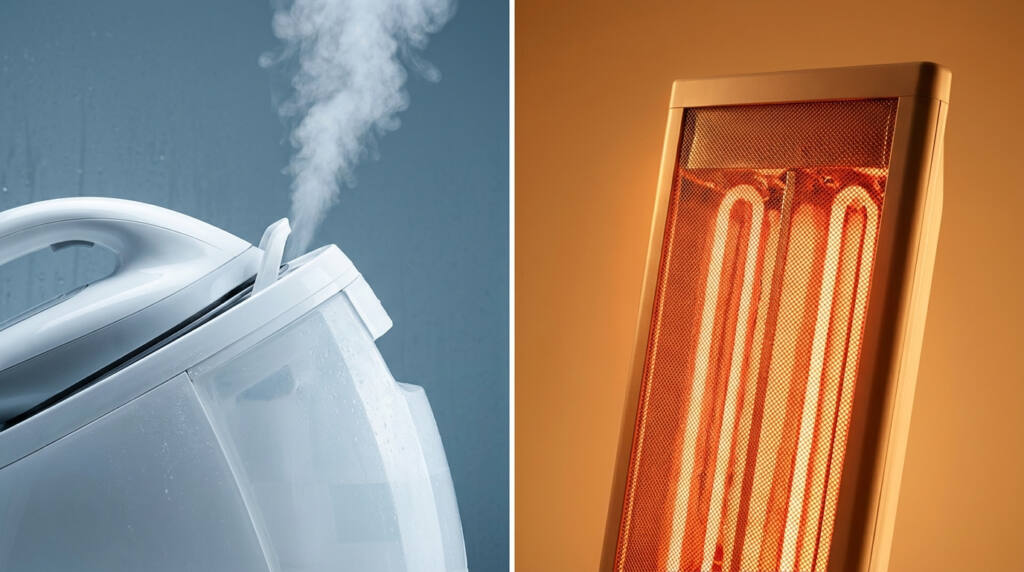
Steam is not automatically better or worse than infrared. The better choice depends on the experience you prefer and how well your home can accommodate the equipment.
If avoiding humidity is your main concern, consider the TopMaster or compare the best infrared sauna blankets for apartments.
4. Plan for Drying and Storage
A pop-up steam sauna should be dried thoroughly after use.
Empty and clean the steam generator according to its manual.
Allow the enclosure to cool before handling or folding it.
Wipe away moisture where instructed, and keep the enclosure open until it is completely dry.
Packing damp material into a closet can create odors and encourage mold growth.
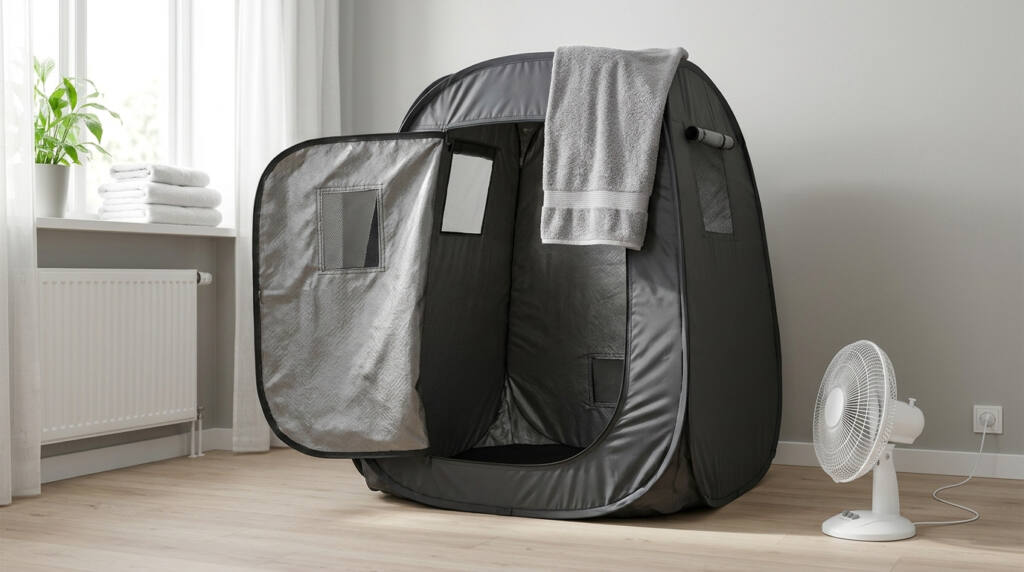
Infrared models also need cleaning because sweat can accumulate on interior surfaces.
Neither type should be stored immediately after a hot session without following the cooldown and cleaning instructions.
5. Check the Chair and User Fit
Portable saunas often include lightweight folding chairs.
Check the maximum supported weight, seat dimensions, and stability requirements.
A chair that fits inside the enclosure is not necessarily comfortable for a long session.
Do not use unstable furniture or improvise seating that could contact heating elements, steam outlets, or electrical components.
6. Consider Apartment Ventilation
Steam releases moisture into the surrounding room when the enclosure is opened.
That moisture needs somewhere to go.
A bathroom with suitable ventilation may be more practical than a carpeted bedroom, but the sauna’s electrical equipment must remain in a manufacturer-approved dry location.
Do not assume that an exhaust fan alone makes every bathroom installation appropriate.
For infrared models, follow the required ventilation and heat clearances even though they do not generate steam.
7. Understand the Temperature Claims
Portable steam saunas may advertise temperatures around 113–115°F, while some infrared enclosures advertise higher maximum settings.
These numbers are not directly comparable across heating methods.
Sensor placement, humidity, warm-up time, and room conditions can affect the actual experience.
Do not judge a sauna only by the highest temperature in its listing.
Comfort, reliable temperature control, and safe operation are more important.
Installation and Monthly Running Costs
Pop-up saunas are generally less expensive to install than permanent cabins, but you should still account for electricity, cleaning, and possible ventilation needs.
Initial Setup Costs
Most portable saunas do not require construction or a new 240V line when the existing electrical supply meets the manufacturer’s requirements.
A typical budget might include:
| Expense | Illustrative cost |
| Pop-up sauna | $100–$300 |
| Compatible floor protection, if required | $15–$40 |
| Cleaning and drying supplies | $10–$25 |
| Optional hygrometer for room humidity | $10–$25 |
| Electrical work, if required | Varies by installation |
Do not assume that an inexpensive sauna makes electrical upgrades unnecessary.
If your existing circuit is unsuitable, have a qualified electrician evaluate it before operating the equipment.
Monthly Electricity Costs
The basic formula is:
Power (kW) × hours per session × monthly sessions × electricity rate
For comparison, assume four 30-minute sessions weekly, or approximately 17 sessions monthly, at an illustrative electricity rate of $0.18/kWh.
| Power rating | Estimated monthly electricity |
| 800W | $1.22 |
| 900W | $1.38 |
| 1,050W | $1.61 |
| 1,500W | $2.30 |
These are simplified full-rated-power examples. Actual consumption varies with heater cycling, warm-up time, session duration, and additional electrical components.
Steam saunas also use water, although the cost of the small quantity used by a generator is usually modest compared with the effort involved in cleaning and drying it.
What About Contrast Therapy?
Some buyers want a portable sauna as part of a hot-and-cold recovery routine.
You can combine a properly installed sauna with a cool shower without buying a cold plunge.
If you want to add a tub later, consider the floor weight, drainage, and water maintenance before purchasing.
Our contrast therapy setup guide explains how to arrange heat and cold equipment safely in limited space.
Frequently Asked Questions
Do pop-up saunas actually get hot enough?
They can provide a noticeable heating experience, but their temperatures are generally different from those of traditional sauna cabins.
Steam models may feel intense because of the humidity, even at lower air temperatures.
Infrared models use radiant heating, which creates a different sensation.
Choose based on the heating method and your comfort rather than expecting a portable tent to reproduce a traditional sauna exactly.
Can I use a pop-up sauna in a small bathroom?
Possibly, if the manufacturer approves the location and the bathroom provides adequate floor space, ventilation, and safe electrical conditions.
Keep plugs, controls, and electrical equipment away from water.
Do not operate a sauna where shower spray or splashing could reach electrical components.
Steam vs. infrared: which is better for an apartment?
Infrared is generally easier to manage when humidity is the main concern.
Steam provides a humid experience but requires more attention to ventilation, condensation, and drying.
Both need suitable electrical connections and cleaning.
Do I need a dedicated electrical circuit?
Not every portable sauna requires one.
The answer depends on its rated current, manufacturer instructions, and other loads on the circuit.
A high-power heating appliance may require a dedicated circuit even if it uses a 120V plug.
How long does a portable sauna take to warm up?
Warm-up time varies by model, room temperature, and heating method.
Some steam units advertise initial steam production within five to ten minutes, but reaching the desired operating conditions may take longer.
Follow the specific manufacturer’s instructions.
Can I leave a pop-up sauna assembled permanently?
Only if the manufacturer permits it and the location remains suitable.
Leaving a steam tent assembled can make drying easier, but it also occupies floor space and requires regular cleaning.
Do not leave heating equipment operating unattended.
Are pop-up saunas safe for beginners?
They can be suitable for some beginners when used according to the manufacturer’s instructions.
Start with conservative temperatures and short sessions.
Stop if you feel dizzy, nauseated, weak, or otherwise unwell.
People with cardiovascular conditions, pregnancy, heat intolerance, or other relevant medical concerns should seek individualized medical guidance before using a sauna.
How do I prevent mold in a steam sauna tent?
Empty and clean the generator as instructed, wipe moisture from the enclosure, and allow all materials to dry completely before storage.
Ventilate the room appropriately.
If mold develops, follow the manufacturer’s cleaning guidance and do not continue using contaminated equipment until the issue is resolved.
Final Recommendations
Best Overall: Homedics Portable Sauna
The Homedics Portable Sauna is our overall choice for solo users prioritizing portability and quick assembly.
Its approximately 13.7-pound weight and collapsible design suit occasional apartment use.
However, confirm the exact heating method, electrical requirements, and temperature specifications before buying.
Best for Two People: Manastin Two-Person Steam Sauna
The Manastin Two-Person Steam Sauna is the strongest option here for shared sessions.
Its two chairs and two generators are useful features, but the larger footprint and combined electrical load require careful planning.
Best Budget and Portable: ZONEMEL Pop-Up Steam Sauna
The ZONEMEL Pop-Up Steam Sauna offers a low advertised price and a lightweight enclosure.
It is worth considering if you want occasional steam sessions without dedicating permanent floor space.
Best Compact Seated Option: Durasage Personal Foldable Steam Sauna
The Durasage Personal Foldable Steam Sauna is suitable for buyers who want a compact seated arrangement.
Its included chair and approximately 31.5-inch footprint are useful, but respect the listed 220-pound weight limit.
Best for Dry Heat: TopMaster Foldable Infrared Sauna
The TopMaster Foldable Infrared Sauna is our preferred option for buyers who want infrared heating without a steam generator.
Its compact footprint and advertised 1,050W panels make it worth comparing with other small infrared systems.
For a more permanent seated experience, see the 5 best infrared saunas for apartments.
Our Overall Verdict
The best pop up sauna is the one that fits your available space, electrical capacity, and willingness to manage moisture.
For occasional solo sessions, the Homedics offers a promising balance of portability and convenience.
For a tighter budget, the ZONEMEL is worth considering.
For buyers who want to avoid steam-related humidity, the TopMaster provides a dry infrared alternative.
Before ordering, verify the current manufacturer’s specifications, measure the assembled and folded dimensions, and plan how you will cool, clean, and store the equipment.
A portable sauna should make your routine simpler, not create electrical hazards or moisture problems in your home.
This post contains affiliate links, including Amazon Associates links. If you buy through them, we may earn a commission at no extra cost to you.