Disclosure: This article contains affiliate links, including Amazon Associates links. If you purchase through them, we may earn a commission at no extra cost to you.
Finding the best cold plunge accessories for a small home means choosing products that make your plunge easier to maintain, safer to use, and less likely to create a mess in your bathroom or garage.
Buying a cold plunge tub is only the first step.
Once you start using it regularly, you need to monitor water temperature, remove debris, clean the tub, manage splashes, and decide how long each session should last.
These details matter even more in apartments and condos.
A little water on a concrete garage floor may be easy to manage. The same amount on laminate flooring beside an upstairs bathroom can create a much bigger problem.
Fortunately, you do not need an expensive collection of accessories.
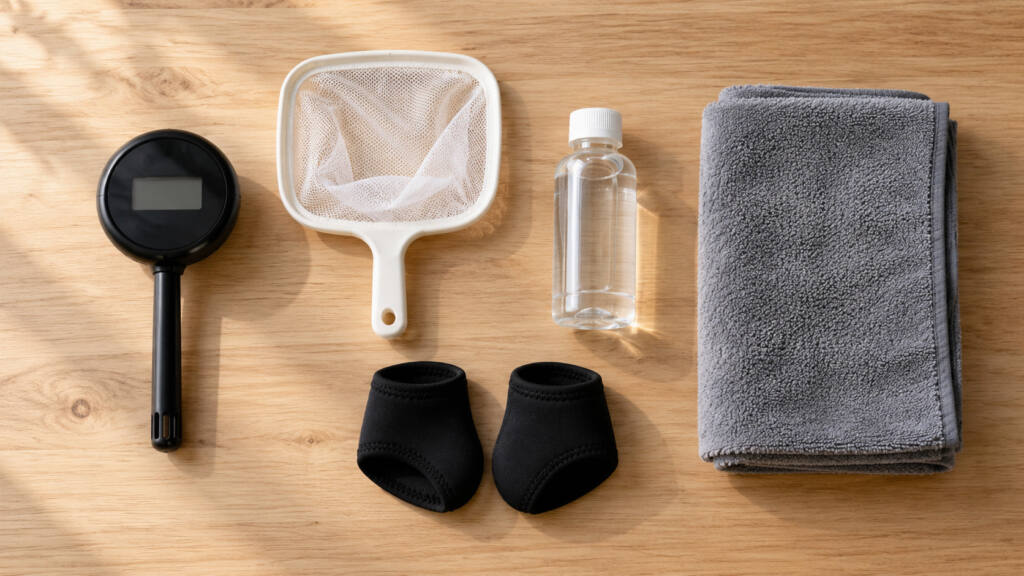
A thermometer, basic cleaning supplies, a compact debris net, and a suitable floor mat can make a portable cold plunge easier to use. Water-treatment products may also help with maintenance when they are compatible with your tub’s sanitation system.
This guide compares five accessories priced at approximately $15–$40 each, focusing on their practical value for US renters and small-space homeowners.
We’ll cover what each product does, its limitations, how to use it safely, and which accessories are worth buying first.
Bottom Line: Which Cold Plunge Accessories Are Worth Buying?
The Ouster 3in1 Cold Plunge Water Treatment is our top pick for buyers who need a water-care product, provided it is compatible with their tub and existing sanitation routine. Its advertised 32 weekly doses make it convenient for regular maintenance, but it must not be mistaken for a complete disinfection system.
The other four accessories serve different purposes:
- Suoimk Floating Thermometer with Timer: Best for checking water temperature and tracking session duration with one compact device.
- The Skimmie Scoop: Best for removing hair, leaves, and floating debris before they reach a filter or settle in the tub.
- Ahpuhtan Cold Plunge Floor Mat: Best for catching splashes around a portable plunge, although it cannot contain a major leak.
- Cramer Cryo-Caps: Best for buyers seeking toe coverage, with an important warning: the listing says not to wash or reuse them.
For most first-time buyers, a reliable thermometer is the most universally useful accessory. Water care is equally important, but the right cleaning or treatment product depends on whether you drain after every session or maintain water between uses.
Quick Comparison: The 5 Best Cold Plunge Accessories in 2026
Prices are approximate planning ranges rather than guaranteed current offers. Confirm the current product description, dimensions, and instructions before purchasing.
| Product | Approximate price | Main role | Best for |
| Ouster 3in1 Cold Plunge Water Treatment | $25–$35 | Water-care support | Weekly maintenance |
| Suoimk Floating Thermometer with Timer | $15–$25 | Temperature measurement and timing | Monitoring sessions |
| The Skimmie Scoop | $15–$20 | Fine-mesh debris removal | Compact cleaning |
| Ahpuhtan Cold Plunge Floor Mat | $25–$40 | Splash absorption and floor protection | Bathrooms and small rooms |
| Cramer Cryo-Caps | $20–$30 | Neoprene toe coverage | Occasional toe protection |
These products perform different jobs. A thermometer does not replace a sanitation system, and a splash mat does not replace waterproof flooring or a drainage plan.
1. Ouster 3in1 Cold Plunge Water Treatment — Best for Water-Care Support
The Ouster 3in1 Cold Plunge Water Treatment is designed to help manage water-care issues associated with regular cold plunge use.
The advertised package provides approximately 32 weekly doses.
Its stated purpose includes managing oils and particles that can accumulate when people use the same tub repeatedly.
For owners of portable plunges, this may be a convenient addition to an established water-maintenance routine.
However, it is important to understand what the product does—and what it does not necessarily do.
Key Details
| Feature | Details |
| Product type | Cold plunge water treatment |
| Advertised quantity | 32 weekly doses |
| Intended function | Managing oils and particles |
| Typical price | $25–$35 |
| Best use | Compatible water-care routines |
Why Water Care Matters
Every time you enter a cold plunge, you introduce small amounts of skin oils, sweat, hair, and other material.
Outdoor tubs may also collect dust, pollen, and leaves.
Even when the water is cold, contamination can build up.
A water-care product may help manage certain residues, but that does not mean the water is disinfected or safe to retain indefinitely.
How to Use It
Follow the product’s current label instructions for the appropriate dose, water volume, treatment frequency, and any required circulation.
The advertised 32 weekly doses should not be interpreted as a universal instruction to add one dose to every tub each week.
The correct amount may depend on your water volume and the manufacturer’s directions.
Do not combine the treatment with chlorine, bromine, peroxide, or other chemicals unless the relevant manufacturers explicitly confirm compatibility.
Does Ouster Replace a Filter or Sanitizer?
Do not assume that it does.
A product advertised for managing oils and particles is not necessarily an EPA-registered disinfectant.
Unless its current label specifically establishes antimicrobial efficacy and approved directions for that use, do not rely on it to kill harmful microorganisms.
Filtration, cleaning, and disinfection serve different purposes.
For an ice-only tub without a manufacturer-approved water-treatment system, draining and cleaning after each session is a conservative approach.
Pros
- Advertised 32-dose supply supports scheduled maintenance.
- Targets common water-care concerns such as oils and particles.
- Compact product is easier to store than bulky equipment.
- May complement a compatible filtration and sanitation system.
Cons
- Should not be treated as a complete sanitizer without verified label claims.
- Requires careful attention to dosing and chemical compatibility.
- Adds an ongoing consumable expense.
- May be unnecessary for users who drain and clean their tub after every session.
Who It’s Best For
Ouster is best for cold plunge owners who retain water between sessions and already have a compatible maintenance system.
It is less essential for renters who use an ice-only tub occasionally and empty it after each use.
Owners who keep water in their tub for a week or two frequently note that this treatment helps keep the water looking clear, but they still have to manually skim out hair and debris and use a separate sanitizer to keep the water safe.
Our assessment: Ouster may simplify part of the water-care routine, but safe sanitation should determine the maintenance plan—not the convenience of a weekly treatment product.
2. Suoimk Floating Thermometer with Timer — Best for Temperature and Timing
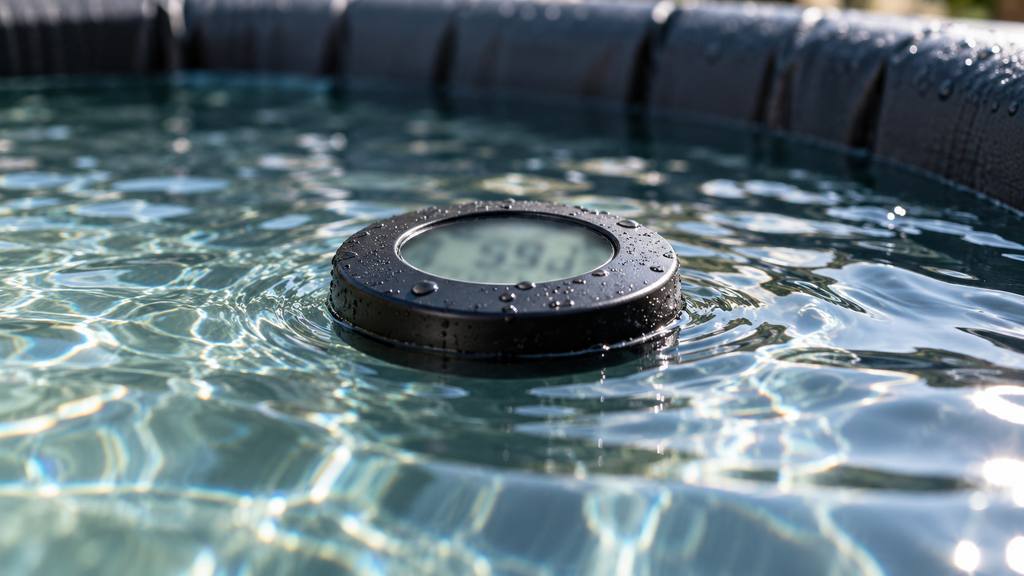
The Suoimk Floating Thermometer with Timer combines two useful cold plunge accessories in one compact device.
It measures water temperature and includes a timer with a maximum advertised duration of 20 minutes.
The thermometer can switch between Fahrenheit and Celsius.
It also carries an IPX6 water-resistance rating.
IPX6 means resistance to powerful water jets under specified test conditions. It does not mean the device is waterproof or rated for continuous submersion.
Key Details
| Feature | Details |
| Product type | Floating thermometer and timer |
| Temperature display | Fahrenheit / Celsius |
| Timer | Up to 20 minutes |
| Water-resistance rating | IPX6 |
| Typical price | $15–$25 |
| Best use | Checking water temperature and tracking sessions |
Why Temperature Measurement Matters
Cold water can feel very different depending on its actual temperature.
A tub at 60°F may feel uncomfortable to a beginner, while water at 40°F introduces a much more intense cold exposure.
You should not rely on how the water feels to estimate its temperature.
A thermometer gives you a more consistent reference.
That is useful when comparing sessions or adjusting how much ice you add.
The Timer Is a Convenience, Not a Target
The 20-minute timer does not mean a 20-minute cold plunge is recommended or safe.
Cold exposure should be approached conservatively.
Beginners may choose much shorter sessions, depending on their health, experience, and water temperature.
Do not use a timer to push through dizziness, chest discomfort, unusual breathing difficulty, or other concerning symptoms.
If you prefer not to buy a separate physical timer, you can also use our free contrast therapy timer on your phone. It is fully mobile-responsive, meaning it acts just like a native app in your browser—so you can safely set it on the counter next to your tub without worrying about a physical device getting ruined by water.
How to Protect the Device
Although the thermometer floats, avoid deliberately submerging it.
Do not leave it underwater or expose it to conditions beyond its specified rating.
Follow the manufacturer’s cleaning and battery-care instructions.
Pros
- Combines temperature measurement and timing.
- Fahrenheit display suits US buyers.
- Floating design makes it easy to access.
- Compact enough to store with other plunge accessories.
Cons
- IPX6 is water-resistant, not fully waterproof.
- A 20-minute timer could be misinterpreted as a recommended session length.
- Battery maintenance may be required.
- Measurement accuracy should be checked against a reliable reference if readings appear inconsistent.
Who It’s Best For
The Suoimk is best for anyone who wants a simple way to measure water temperature and track session duration.
It is particularly useful for first-time plunge owners who want consistent information without buying two separate devices.
Owners who use this floating thermometer frequently mention that the timer is incredibly helpful for avoiding checking their phone with wet hands, but they also warn that the unit should be taken out and dried off after every session to prevent moisture from getting inside the battery compartment.
Our assessment: This is one of the most useful first purchases because temperature measurement helps you manage cold exposure, while the timer removes the need to handle a phone near water.
3. The Skimmie Scoop — Best Compact Debris Remover
The The Skimmie Scoop is a small fine-mesh net designed to remove floating debris from water.
Its advertised dimensions are approximately 12 inches long, 5 inches wide, and 2 inches deep.
The listed weight is approximately 4.6 ounces.
It also has a suction-cup handle, which may provide a convenient storage option on a compatible smooth surface.
Key Details
| Feature | Details |
| Product type | Fine-mesh debris scoop |
| Dimensions | Approximately 12″ × 5″ × 2″ |
| Weight | Approximately 4.6 oz |
| Handle feature | Suction cup |
| Typical price | $15–$20 |
| Best use | Removing floating debris |
Why a Small Net Is Useful
Hair, leaves, lint, and other debris can accumulate on the water surface.
Removing that material before it settles makes cleaning easier.
If your plunge uses a circulation pump and filter, a debris net can also help prevent larger particles from reaching the system.
A small net is particularly practical for portable tubs because it does not require permanent mounting or electrical power.
How to Use It
Move the net slowly across the water surface to collect floating material.
Avoid scraping delicate liners or forcing the net against inflatable seams.
After use, rinse the mesh and allow it to dry.
Do not use the same scoop for unrelated household cleaning tasks that could introduce chemicals into the plunge.
Suction-Cup Storage
The suction-cup handle may attach to certain smooth, nonporous surfaces.
However, suction cups can release over time, especially on textured tile or damp surfaces.
Do not depend on the suction cup to support other equipment.
Owners who keep a small net beside their plunge frequently find that removing floating debris takes less time than cleaning it after it settles, so store the scoop somewhere dry and easy to reach.
What a Debris Net Cannot Do
A mesh scoop does not remove dissolved contaminants or disinfect water.
It also cannot replace a filtration system where one is required.
Think of it as a simple cleaning tool rather than a complete water-treatment solution.
Pros
- Fine mesh helps remove floating hair and debris.
- Compact dimensions suit small bathrooms and garages.
- Lightweight at approximately 4.6 ounces.
- Suction-cup handle offers a possible storage option.
Cons
- Does not disinfect water.
- Cannot remove dissolved oils or microscopic contaminants.
- Suction cup may not adhere reliably to textured surfaces.
- Requires rinsing and drying after use.
Who It’s Best For
The Skimmie Scoop is best for people who leave water in their plunge between sessions and want an easy way to remove visible debris.
It is also useful for outdoor or garage installations where dust and leaves may enter the tub.
Buyers often note that the suction cup is great for sticking to the side of a smooth plastic tub or glass shower door, but it will not stick to textured tile or rough concrete, so you may need to store it on a shelf instead.
Our assessment: A compact net is a low-cost convenience accessory, especially when your tub has no built-in surface skimmer.
4. Ahpuhtan Cold Plunge Floor Mat — Best for Splash Protection
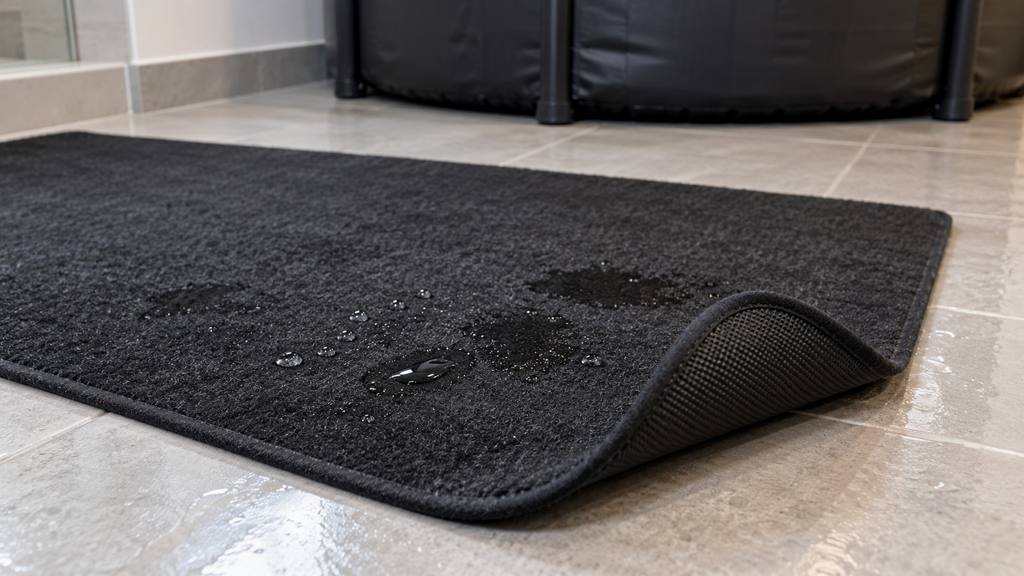
The Ahpuhtan Cold Plunge Floor Mat is designed to catch splashes and provide a protective layer around a cold plunge.
It has a felt surface with rubber backing.
The felt layer can absorb small amounts of water, while the backing is intended to help limit moisture transfer to the surface below.
For apartment owners and renters, this type of accessory can be useful when stepping out of a plunge.
However, a mat is not a waterproof containment system.
Key Details
| Feature | Details |
| Product type | Cold plunge floor mat |
| Surface material | Felt |
| Backing | Rubber |
| Listed dimensions | Conflicting: 47″ × 70″ and 40″ × 63″ |
| Typical price | $25–$40 |
| Best use | Catching splashes |
Important Size Warning
The product information contains conflicting dimensions: 47″ × 70″ in some listing details and 40″ × 63″ in others.
That is a meaningful difference for a small bathroom.
The larger size covers approximately 22.8 square feet, while the smaller size covers approximately 17.5 square feet.
Verify the dimensions of the exact selected variant before ordering.
Do not plan your bathroom layout around one measurement until the seller confirms it.
Owners who place protective mats beneath portable plunges frequently discover that a few inches of extra coverage can affect door clearance and drainage access, so measure the available floor area before choosing a size.
What a Floor Mat Can Do
A mat may help catch small splashes when entering or exiting the tub.
It can also provide a designated place to stand while drying off.
Depending on the flooring and backing, it may help reduce direct contact between the tub and the floor.
However, the mat’s performance depends on its materials and the surface beneath it.
What a Floor Mat Cannot Do
A felt-and-rubber mat cannot be relied upon to contain a major leak.
It also does not make an unsuitable floor structurally safe.
A 90-gallon plunge contains approximately 751 pounds of water at its advertised capacity.
Putting a mat underneath does not change that load.
Use our cold plunge weight calculator to estimate the complete occupied weight.
How to Position It
Place the mat on a clean, level surface according to the manufacturer’s instructions.
Check that the backing is compatible with your flooring.
Some rubber-backed products can discolor or react with certain floor finishes.
Allow the mat to dry thoroughly after use, and inspect the floor beneath it for trapped moisture.
Pros
- Felt surface can help catch routine splashes.
- Rubber backing provides a protective layer beneath the felt.
- Useful for creating a designated drying area.
- May reduce the amount of water tracked across the room.
Cons
- Conflicting listed sizes require verification.
- Cannot contain a major leak or overflowing tub.
- May trap moisture if left wet on the floor.
- Rubber backing may not be compatible with every floor finish.
Who It’s Best For
The Ahpuhtan mat is best for owners who use a plunge on a suitable bathroom, garage, or utility-room floor and want to manage everyday splashes.
It is not a substitute for waterproof flooring, controlled drainage, or leak prevention.
Renters frequently mention that while the felt top absorbs splashes well, the rubber backing can trap moisture against the floor if you don’t hang it up to dry after use, which can damage wood or laminate flooring over time.
Our assessment: A splash mat is useful, but choosing the correct dimensions and drying it properly are more important than simply buying the largest available size.
5. Cramer Cryo-Caps — Best for Occasional Toe Coverage
The Cramer Cryo-Caps are neoprene toe covers intended to provide a layer of coverage during cold exposure.
They are listed as one-size.
Some cold plunge users find their toes become uncomfortable before the rest of their body.
Toe covers may provide a physical barrier that changes how the cold feels around the toes.
However, they should not be treated as medical protection against cold injury.
Key Details
| Feature | Details |
| Product type | Neoprene toe covers |
| Size | One-size |
| Material | Neoprene |
| Typical price | $20–$30 |
| Best use | Occasional toe coverage |
Important Reuse Warning
The listing includes the instruction: “Do not reuse or wash.”
That matters if you plan to use toe covers several times weekly.
Do not assume they can be rinsed, dried, and reused like ordinary neoprene socks.
Before buying, confirm the current manufacturer’s instructions and whether the product is intended for repeated immersion.
If regular reuse is not permitted, the ongoing cost could make this a poor choice for frequent cold plunging.
Do Toe Covers Make Cold Plunging Safer?
Not necessarily.
A layer of neoprene may change the sensation of cold exposure, but it does not eliminate the body’s response to cold water.
Do not use toe covers to justify colder water or longer sessions.
If your toes become painfully cold, numb, or discolored, exit the water and warm up appropriately.
Pros
- Provides an additional layer of toe coverage.
- Compact and easy to store.
- One-size design simplifies selection.
- May appeal to users who find toe exposure especially uncomfortable.
Cons
- Listing says not to wash or reuse.
- One-size fit may not work for everyone.
- Not a substitute for conservative cold-exposure practices.
- Potentially poor value for frequent users if single-use instructions apply.
Who It’s Best For
Cramer Cryo-Caps are best for occasional users who want toe coverage and are willing to follow the product’s specific use and disposal instructions.
They are not our preferred first purchase for someone building a basic cold plunge accessory kit.
Owners who use these for occasional ice baths often find they help take the edge off the cold for their toes, but because they are not meant to be washed or reused, most people find a pair of neoprene dive socks is a better long-term investment.
Our assessment: The reuse restriction is the deciding factor. Buyers planning frequent sessions should clarify the manufacturer’s instructions before spending money on these covers.
Buying Guide: What Cold Plunge Accessories Do You Actually Need?
You do not need every accessory on this list.
For a small apartment or garage setup, the best approach is to buy products that solve a specific problem.
1. Prioritize Water Maintenance
A cold plunge requires a cleaning and water-management routine.
The right routine depends on whether you drain after each session or retain water between uses.
If You Drain After Every Session
You may only need:
- A suitable cleaning product approved for the tub material.
- A soft cloth or sponge.
- A reliable drain hose or utility pump.
- A thermometer.
A weekly water-treatment product may offer little value if the water is discarded after every session.
If You Keep Water Between Sessions
You need a more comprehensive plan.
That may include filtration, an appropriate disinfection system, water testing, and scheduled cleaning.
Do not assume a water-care additive replaces disinfection.
If you are unsure which chemicals are compatible with your plunge, follow the tub manufacturer’s instructions rather than adapting a swimming-pool routine.
For a complete breakdown of how to test, filter, and sanitize your water safely, see our guide to keeping cold plunge water clean.
2. Separate Safety Accessories From Convenience Accessories
Some accessories make cold plunging easier.
Others help you manage risks.
A thermometer is useful because it tells you the actual water temperature.
A timer can help you track sessions, but it does not determine a safe duration.
A floor mat catches splashes, but it does not prevent flooding.
Toe covers may improve comfort, but they do not protect against all effects of cold exposure.
The most important safety measures are appropriate water temperature, conservative immersion, safe entry and exit, structural support, and reliable drainage.
3. Choose Compact Accessories for Small Spaces
Apartment storage is limited.
A large cleaning kit can quickly become clutter.
Look for accessories that fit into a small storage basket or cabinet.
The Skimmie Scoop is an example of a compact cleaning tool.
A combined thermometer and timer also reduces the need to store separate devices.
Before buying larger accessories, measure your available storage.
Our sauna space planner is designed for sauna layouts, but the same measurement-first approach is useful when planning a small wellness corner.
4. Check Floor Protection and Moisture Management
A cold plunge can create water on the floor even when the tub does not leak.
People drip water when entering and exiting.
Condensation may also develop on some equipment surfaces.
A suitable splash mat can help manage small amounts of water.
However, water trapped beneath a mat can damage certain flooring materials.
Lift and dry the mat regularly.
For wood, laminate, or other moisture-sensitive flooring, consider whether the location is suitable for a water-filled tub at all.
5. Plan for Electrical Safety
An ice-only cold plunge may not need electrical power.
A chiller-equipped setup does.
If you use a chiller, pump, or other powered accessory, follow the equipment manufacturer’s electrical instructions.
Required GFCI protection, appropriate receptacles, and safe cord routing are especially important near water.
Do not use a power strip or ordinary extension cord to work around an inconvenient outlet.
A battery-powered thermometer may be convenient because it avoids a cord near the tub.
6. Check the Filled Weight Before Adding Equipment
Accessories are usually light compared with the water.
But the complete installation still matters.
For example:
| Water volume | Water weight alone |
| 40 gallons | 334 lb |
| 50 gallons | 417 lb |
| 75 gallons | 626 lb |
| 90 gallons | 751 lb |
| 110 gallons | 917 lb |
Add the tub, occupant, and any equipment.
A mat does not distribute weight in a way that automatically makes an unsuitable floor safe.
If the structure is uncertain, obtain a qualified assessment before filling the tub.
7. Avoid Buying Accessories That Do Not Match Your Routine
If you use a portable plunge once weekly and drain it afterward, a complicated chemical-maintenance kit may be unnecessary.
If you use a refrigerated plunge every day and retain the water, proper filtration and sanitation become more important.
If your tub is installed outdoors, a debris scoop may be especially useful.
If you plunge in a bathroom with waterproof flooring and a nearby drain, an oversized mat may be unnecessary.
Choose accessories based on actual problems rather than building a large collection.
8. Budget for Monthly Maintenance
Accessory costs do not end with the initial purchase.
Water-care treatments, cleaning products, filters, and some protective accessories may need replacement.
For example, a $30 treatment package advertised to contain 32 weekly doses would average approximately $0.94 per week, or about $4.06 per month, if used at exactly one dose weekly.
That calculation does not establish that one dose is appropriate for your tub or that the treatment is sufficient for sanitation.
A thermometer and debris net may have lower recurring costs, although batteries and replacement parts can still be necessary.
Toe covers may become expensive if the manufacturer’s instructions prohibit reuse.
The best accessory budget accounts for both purchase price and ongoing use.
A Practical Cold Plunge Accessory Setup for Small Apartments
For a renter with a portable ice-only tub, I would keep the setup simple.
Start with a reliable thermometer, a controlled drainage arrangement, and compatible cleaning supplies.
Add a small debris net if the tub collects visible particles.
Use a splash mat only where the flooring is suitable and the mat can be dried thoroughly.
Do not add chemical treatments unless you understand their purpose and compatibility.
For a chiller-equipped tub, the priorities change.
Filtration, manufacturer-approved sanitation, water testing, and electrical safety become more important.
If you are still deciding which type of tub to purchase, see our guide to the best cold plunge for renters.
For people considering a customized setup, our DIY cold plunge guide explains the additional drainage, cleaning, and safety requirements.
Frequently Asked Questions
Do I really need a water-treatment product for my cold plunge?
Not necessarily.
If you drain and clean an ice-only tub after each session, a separate weekly treatment may not be needed.
If you retain water between sessions, you need an appropriate filtration, sanitation, testing, and maintenance routine.
A product designed to manage oils and particles should not automatically be treated as a disinfectant.
Can I use a pool thermometer for a cold plunge?
Yes, if it is suitable for the expected temperature range and designed for water use.
Choose a thermometer that provides readable measurements in Fahrenheit.
A floating model is convenient, but check its water-resistance rating and handling instructions.
How do I keep cold plunge water clean without a filter?
For a basic portable tub without filtration or an approved sanitation system, draining and cleaning after each session is a conservative approach.
Remove visible debris, wash the tub using compatible products, rinse it, and allow it to dry.
Do not rely on cold temperature alone to keep water sanitary.
Is a cold plunge floor mat necessary?
Not always.
A mat can help catch routine splashes and provide a designated drying area.
However, it cannot prevent damage from a major leak and does not make an unsuitable floor structurally safe.
Choose one based on your flooring, drainage, and available space.
Are floating thermometers waterproof?
Not necessarily.
Water-resistant ratings have specific meanings.
The Suoimk model in this guide is advertised with an IPX6 rating, which does not establish suitability for continuous underwater immersion.
Follow the manufacturer’s instructions.
How long should I stay in a cold plunge?
There is no single safe duration for everyone.
The appropriate exposure depends on water temperature, individual health, experience, and how your body responds.
Start conservatively, avoid breath-holding, and exit if you develop concerning symptoms.
Do not treat a timer’s maximum setting as a recommended session length.
Can I reuse Cramer Cryo-Caps?
The listing includes an instruction not to wash or reuse them.
Follow the current manufacturer’s directions and seek clarification before planning repeated use.
Do not assume they are reusable simply because they are made from neoprene.
What are the first three accessories I should buy?
For a basic portable plunge, prioritize a reliable thermometer, a suitable drainage solution, and compatible cleaning supplies.
A debris scoop and splash mat can be useful additions.
If you retain water between sessions, an appropriate sanitation and testing system takes priority over convenience accessories.
Final Recommendations
Best Overall Water-Care Accessory: Ouster 3in1 Cold Plunge Water Treatment
The Ouster 3in1 Cold Plunge Water Treatment is our water-care pick for owners who maintain water between sessions and have confirmed compatibility with their existing sanitation routine.
Its advertised 32 weekly doses provide a convenient maintenance format.
However, it should not replace approved disinfection, filtration, or cleaning.
Best for Timing and Temperature: Suoimk Floating Thermometer with Timer
The Suoimk Floating Thermometer with Timer is the most universally useful accessory in this comparison.
It combines temperature measurement and session timing in one compact product.
Remember that its IPX6 rating means water-resistant, not suitable for continuous submersion.
Best for Floors: Ahpuhtan Cold Plunge Floor Mat
The Ahpuhtan Cold Plunge Floor Mat is useful for managing routine splashes around a portable tub.
Verify whether the selected product measures 47″ × 70″ or 40″ × 63″ before purchasing.
It is not a substitute for waterproof flooring or a proper drainage plan.
Best for Debris Removal: The Skimmie Scoop
The The Skimmie Scoop is a compact cleaning tool that can help remove visible floating debris.
It is especially useful for tubs installed in garages or other areas where dust and leaves may accumulate.
Best for Occasional Toe Coverage: Cramer Cryo-Caps
The Cramer Cryo-Caps may appeal to users who want additional toe coverage.
However, the listing’s instruction not to wash or reuse them is a significant limitation.
Confirm the manufacturer’s current directions before buying them for regular use.
Our Overall Verdict
The best cold plunge accessories are the ones that solve everyday maintenance and safety problems without making your small space harder to manage.
For most new owners, begin with accurate temperature measurement, reliable drainage, and a practical cleaning routine.
Add a debris net if you need it.
Use a floor mat to manage splashes, but do not expect it to protect against flooding.
Choose water-treatment products based on the requirements of your specific tub and sanitation system.
A small, carefully selected accessory kit is usually more useful than buying everything at once.
This post contains affiliate links. If you buy through them, we may earn a commission at no extra cost to you.